
One thing is certain: it’s my first time reading this book. I thought I did, but I think I skipped right to Children of Dune and God Emperor, because I’m confident I would remember this.
Heartbreaking and astonishingly beautiful, I know I’m a voice outside the chorus but in retrospective I feel Dune makes very little sense without Messiah or, at least, it’s a very partial work in which the true meaning of events is buried deep under shifting sands.
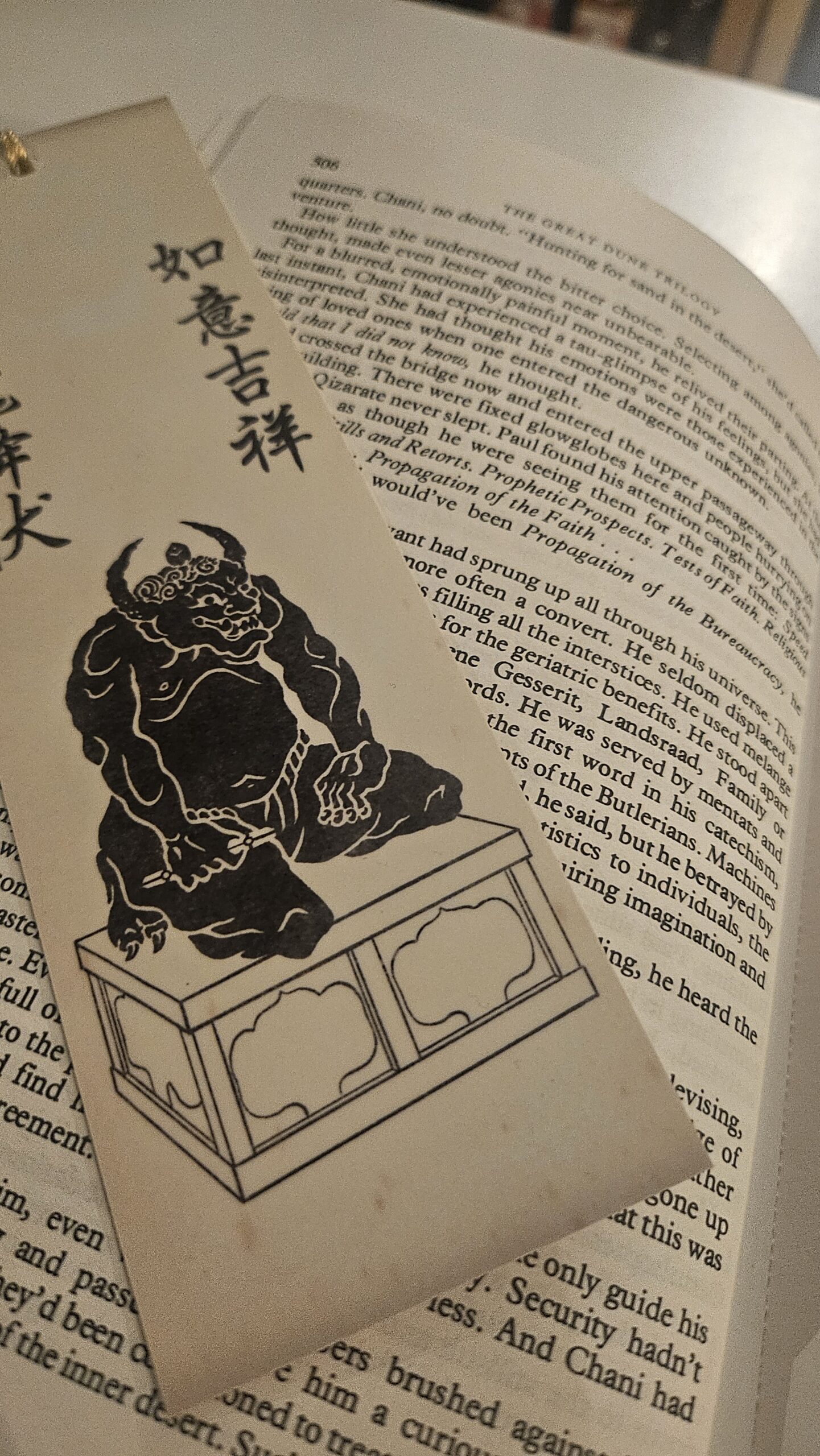
I don’t know why Herbert decided to split this into a separate book. Or, at least, I have the feeling that he wanted to escape his fate just like Paul is trying to escape his, because when you write about a hero who can’t and won’t succeed… well, part of the audience you attracted with Dune is bound not to understand, to disown you and recoil in disbelief as if you betrayed them. Look at what happened with Joker 2.
With Messiah being a separate book, people who didn’t understand Dune can still say it’s their favourite book, Paul is their favourite hero, and then it’s all Messiah‘s fault for ruining the grand story of a boy who conquers an empire. Dune was never that story. But they can carry on not knowing.
A hero’s journey was never my understanding of Dune, that was never my expectation, and yet Messiah went above and beyond: it’s a book where religion is painted as the most horrendous thing one can invent alongside nobility (two principles I wholeheartedly agree with), politics is so disgusting it taints you upon contact, and the future is an absolutely terrifying thing.
In this aspect, I think Herbert gave us one of the most original and pearl-clutching approaches to prescience, an approach that can also be explored for time travel: the basic idea that only one oracle can look at an event in the future and two oracles, looking at the same thing, will riddle it full of holes for the other, holes in which a conspiracy might as well creep in.
The approach to conscience is also very nice, and I confess I didn’t understand at first that’s where the whole thing with Hyat was going (but that would be a major spoiler). I guess the conspiracy got me fooled as well.
The weak points still remain where Herbert is trying to write women and his approach to fertility but hey, it’s the 70s in the US, I guess.



No Comments