
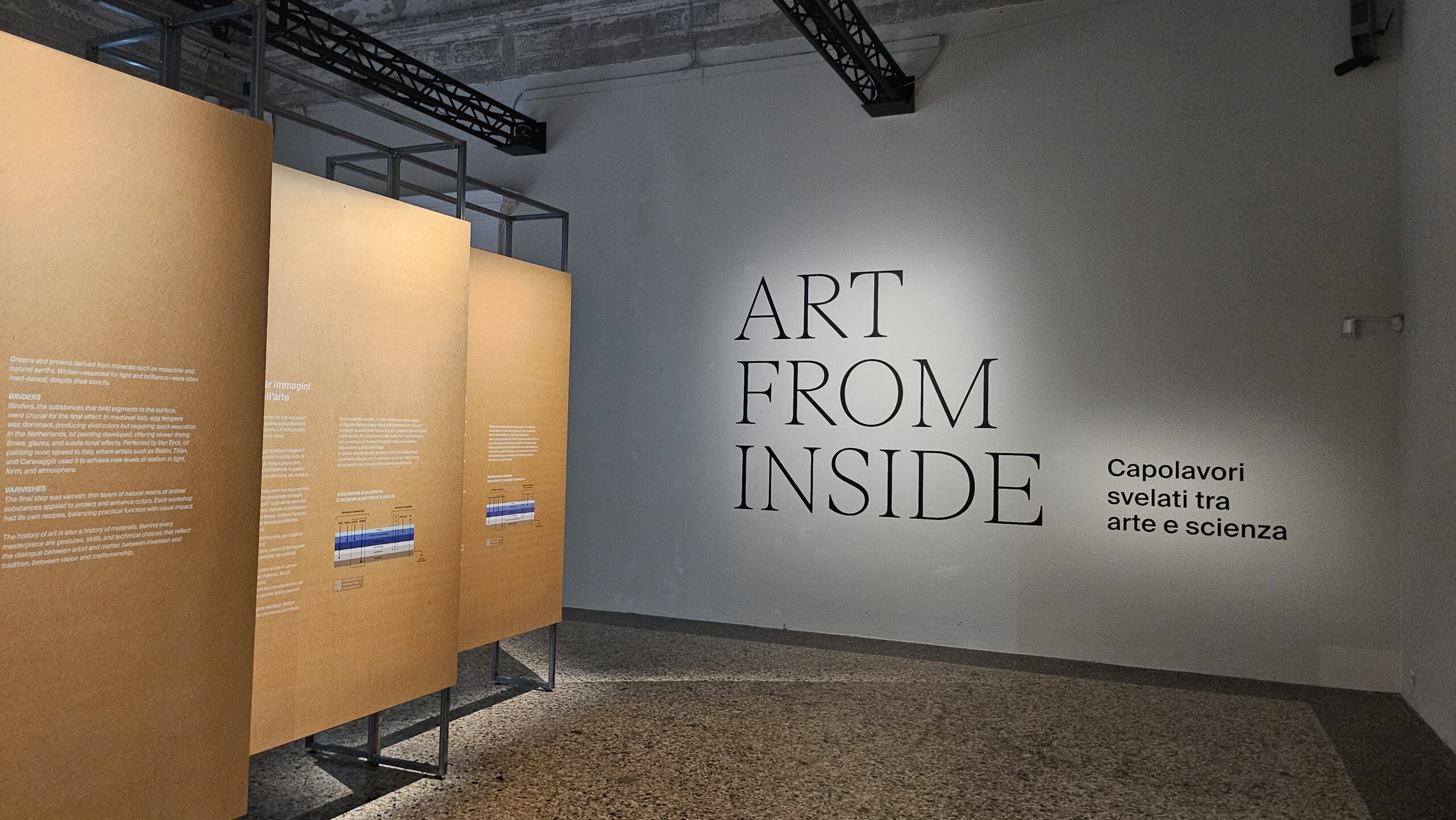
Today we talk about a very special exhibition here in Milan, one that approaches art from a not-so-common angle, and that seems to collect the threads of some other exhibitions I really enjoyed here in the city. The exhibition is titled “Art from Inside: Masterpieces Revealed between Art and Science” and, although the title might draw you into error, it doesn’t have anything to do with Escher’s show but has everything to do with Caravaggio, Lorenzo Lotto and Beato Angelico.
The Exhibition
The show takes place in the heart of Milan, within some of the best and most emotionally intense rooms of Palazzo Reale, and it’s remarkable in many ways, as it challenges our perceptions of art and invites a deeper exploration into the invisible layers of masterpieces. Subtitled Masterpieces Revealed between Art and Science, the show reveals an extraordinary dialogue between art history and cutting-edge science, offering visitors a journey not only in front of great works but inside them.
Drawing from art spanning the 15th to the 18th century, the exhibition presents seven celebrated works and uncovers what lies beneath their visible surfaces: underdrawings, afterthoughts, compositional changes, restorations and the very technical stratigraphy of the materials.
If you’ve been following the recent exhibitions in Milan — or just following me, as it happens — you’ll remember some remarkable discoveries made by science in antique art, particularly one when it came to Piero della Francesca’s central subject for a dismembered altarpiece: there, advanced diagnostic tools revealed traces of angel wings and stone basements and robes and details overflowing through the composition from the central portion, and gave us a definite idea of what was depicted there. And it was exciting like a thriller investigation.

That’s what this new exhibition is all about. Through non-invasive diagnostics, large-scale reproductions and immersive multimedia installations, visitors can peer into the “anatomy” of art pieces, discovering not just what we see, but how these works were made, revised, and conserved. About their history and struggles. About the way their creators worked.
You won’t find original pieces in this exhibition, but what you’ll find is so much more: it’s a meeting point between disciplines, where art history meets physics and chemistry, conservation science meets aesthetics, archive meets digital installation. Promoted by Fondazione Bracco in collaboration with Sole 24 Ore Cultura and the City of Milan’s culture department, it positions itself as a bridge between accessible public exhibition and specialist research. The most remarkable aspect is that admission is free of charge. For anyone interested in the hidden craft of the old masters, or in how science can enhance our cultural understanding, this show is an invitation to look beyond the surface.

1. Beato Angelico and the Silver’s Cupboard
The first piece is an old acquaintance: we saw it at Museo Diocesano at their temporary exhibition before Christmas (here‘s a piece-by-piece rundown).
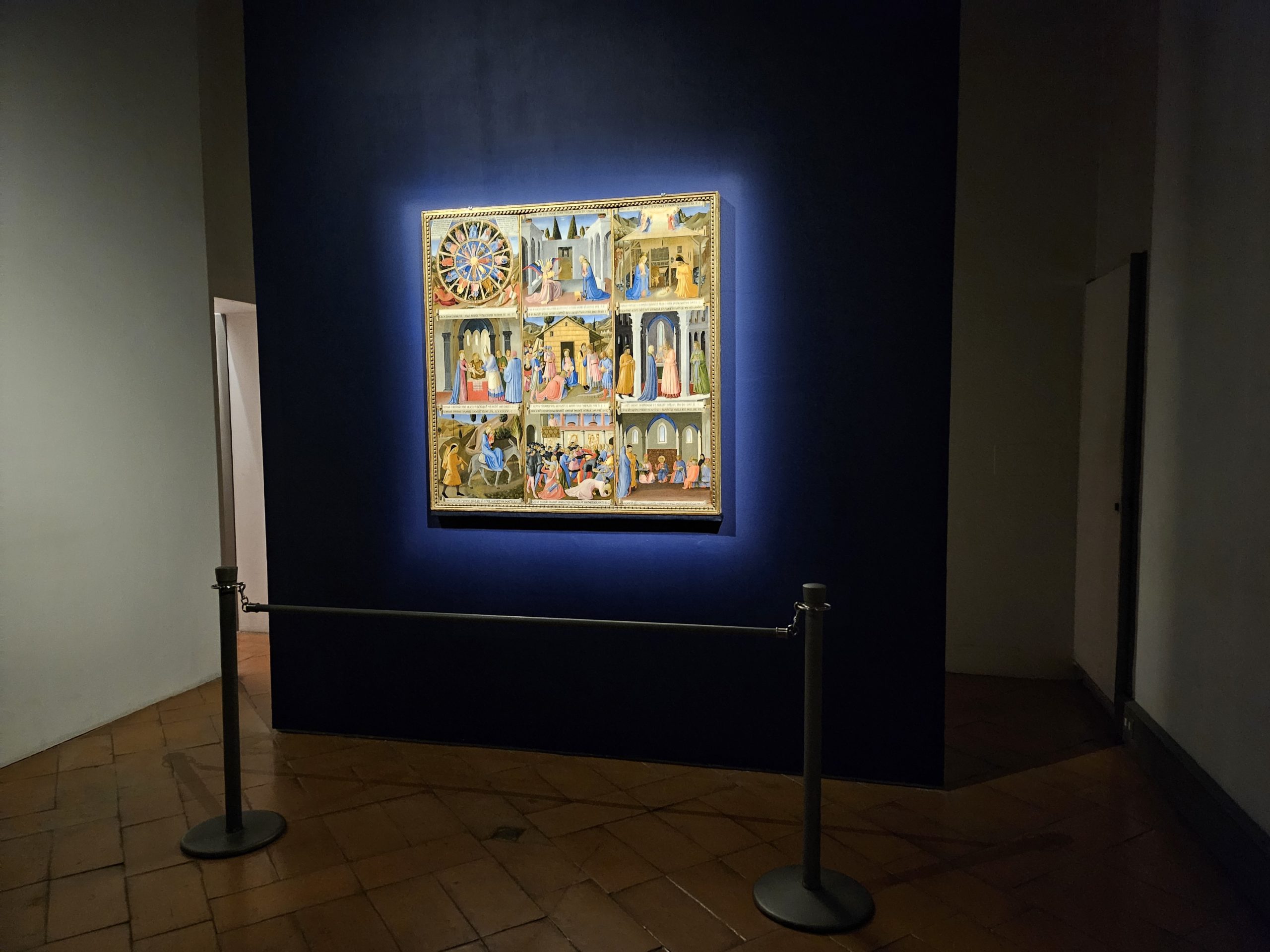
At the intersection of art and science lies the ability to see what the artist once saw and even what they chose to hide. Art from Inside opens this dialogue through diagnostic imaging, where the canvas becomes a landscape of data, material, and spectral signatures.
While to the naked eye a painting appears as a seamless harmony of colour, form, and texture, scientific investigation uncovers a layered narrative where each pigment, each brushstroke, each alteration holds information about artistic intent and material evolution. The technologies showcased in the exhibition, such as FORS, XRF, and UV fluorescence imaging, are part of a rapidly expanding field known as technical art history, which combines conservation science with digital imaging, physics, and chemistry.
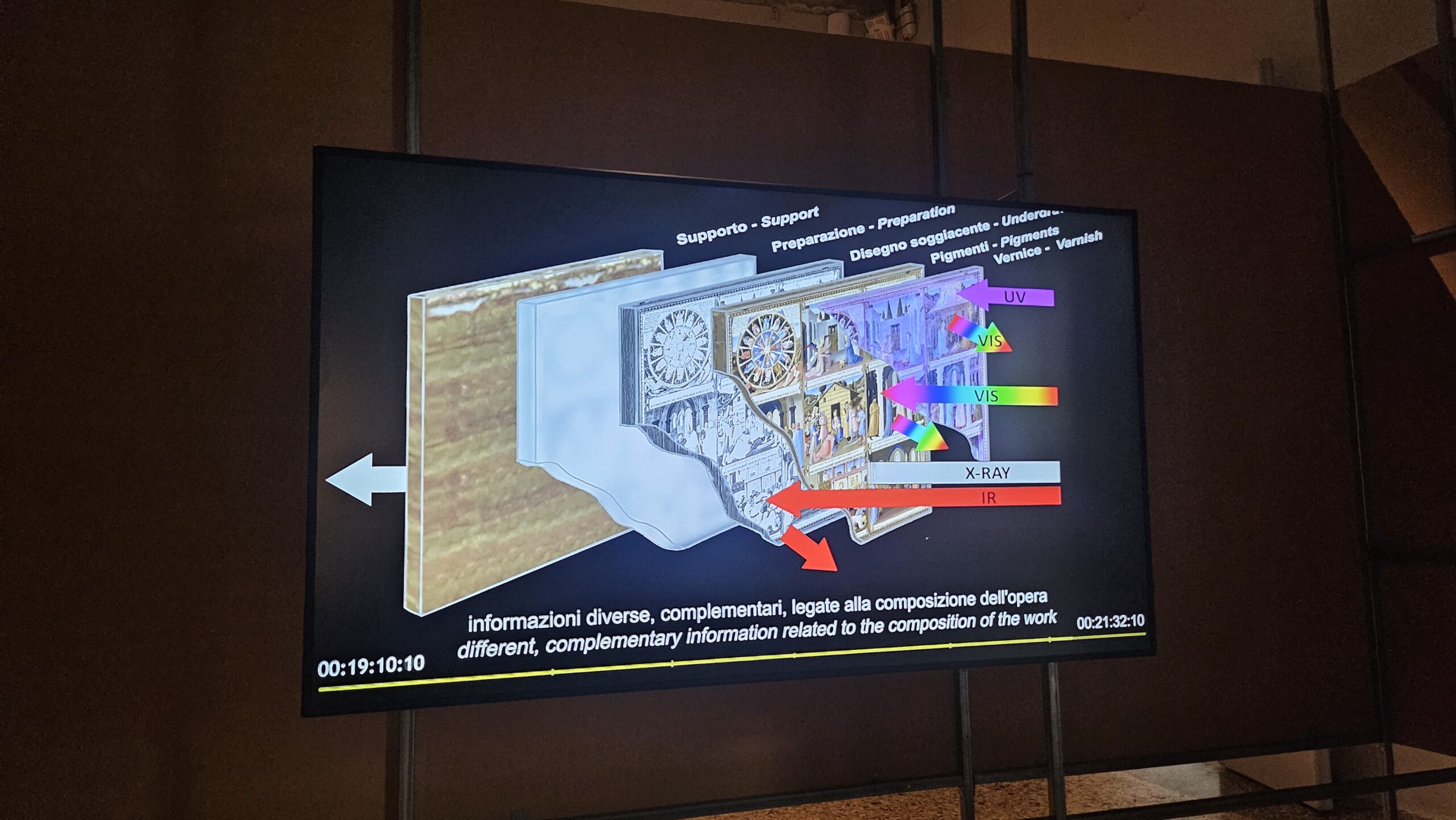
Light, in its various wavelengths, is the key instrument for unveiling hidden truths within a painting. Fibre Optic Reflectance Spectroscopy (FORS) operates much like a conversation between light and pigment: by illuminating the surface with visible and near-infrared light and analysing what is reflected, scientists can map the spectral fingerprints of materials, which in turn allows them to identify pigments such as lapis lazuli, cinnabar, or even verdigris, once the alchemical treasures of Renaissance studios.
X-ray Fluorescence (XRF) goes deeper still, analysing the elemental composition of the paint without removing a single flake. The technique seeks the presence of lead, copper, or iron — the chemical backbone of pigments like lead white or red ochre — and exposes the subtle substitutions and mixtures used by artists over time, offering evidence of workshop practices and regional pigment availability.
Ultraviolet and infrared imaging complement this material mapping. Infrared reflectography, for example, can penetrate beneath the paint layers to reveal underdrawings, the ghostly sketches of the artist’s first intentions. Ultraviolet-induced fluorescence (UVF), by contrast, captures the glowing traces of varnishes or retouches invisible in daylight, exposing the dialogue between the original hand and later restorers.

In the case of Beato Angelico’s panel, this scientific scrutiny reveals a master both meticulous and experimental: his use of mineral pigments, layered in fine glazes, shows a sensitivity to light and transparency that anticipated later Renaissance advancements. Take for instance the collar and insides of the Virgin Mary’s mantle in the piece shown above: the composition is a refined mixture of ochre and lapis lazuli that’s highly experimental and it’s nowhere to be found in the rest of the panel. Was the artist trying out something new to be used more extensively later on? It’s certainly possible, but we have to remember that this isn’t a work done in the artist’s youth. In fact, it’s one of the latest he did. This either means that he continued experimenting throughout his life or that he liked to hide small gems of unusual colours where only some people knew they had to look. Now, centuries later, we’re part of those people.

2. Lorenzo Storioni’s Piccolo Bracco
After the luminous precision of Beato Angelico’s pigments, the first half of the adjacent room highlights a different kind of intimacy. The Violino Piccolo Bracco, crafted by Lorenzo Storioni in late eighteenth-century Cremona, stands at the crossroads of craftsmanship, art and engineering, and diagnostic methods allow us to explore the biography of a material object in wood grain, varnish, and the traces of centuries of touch.

Cremona’s luthiers were already legendary by Storioni’s time. Working in the shadow of people like Stradivari and Guarneri, he represented the last flowering of that golden age, when violin-making was as much empirical science as art. His instruments often carried the experimentation of a transitional period: new varnishes, modified neck joints, and evolving soundboards responding to the demands of orchestral performance.
X-ray radiography allows us to see beyond the polished maple and spruce, penetrating to the very skeleton of the violin. Much like in medical imaging, X-rays travel through the material, and denser areas — those reinforced with metal pins or filled with aged varnish — appear bright in the radiograph. In Storioni’s instrument, these images reveal an invisible scaffolding: the alignment of the neck, the integrity of the internal blocks, and even the pattern of historical reinforcements.
Such information is invaluable for conservators too, as it can distinguish between original craftsmanship and later repairs, and maps the violin’s “surgical history” over two centuries. In some cases, the grain direction or minor cracks hidden under layers of polish emerge, allowing restorers to predict how the instrument will behave under tension and sound.
What’s funnier, however, is that some of these repairs seem to date back to when the violin was being constructed, a sign that the client wasn’t as demanding and refined as it happened in the previous decades.

If X-rays give us the bones, ultraviolet reflectance (UVR) reveals the skin, a delicate outer layer that defines the instrument’s visual and acoustic character. Under UV light, varnishes fluoresce in distinct hues depending on their composition and age: for instance, a warm glow may signal original eighteenth-century resins; a cooler blue fluorescence might point to later retouches or modern restorations. In this case, we have traces of milk-based glue, a material that’s distinctive of its age.
3. Giovanna Garzoni’s Portraits
After the dense materiality of Storioni’s violin, the second half of this room hosts the precision and grace of Giovanna Garzoni, one of the few women painters of the seventeenth century to secure a place among the courts and academies of Europe. I wrote about her here.
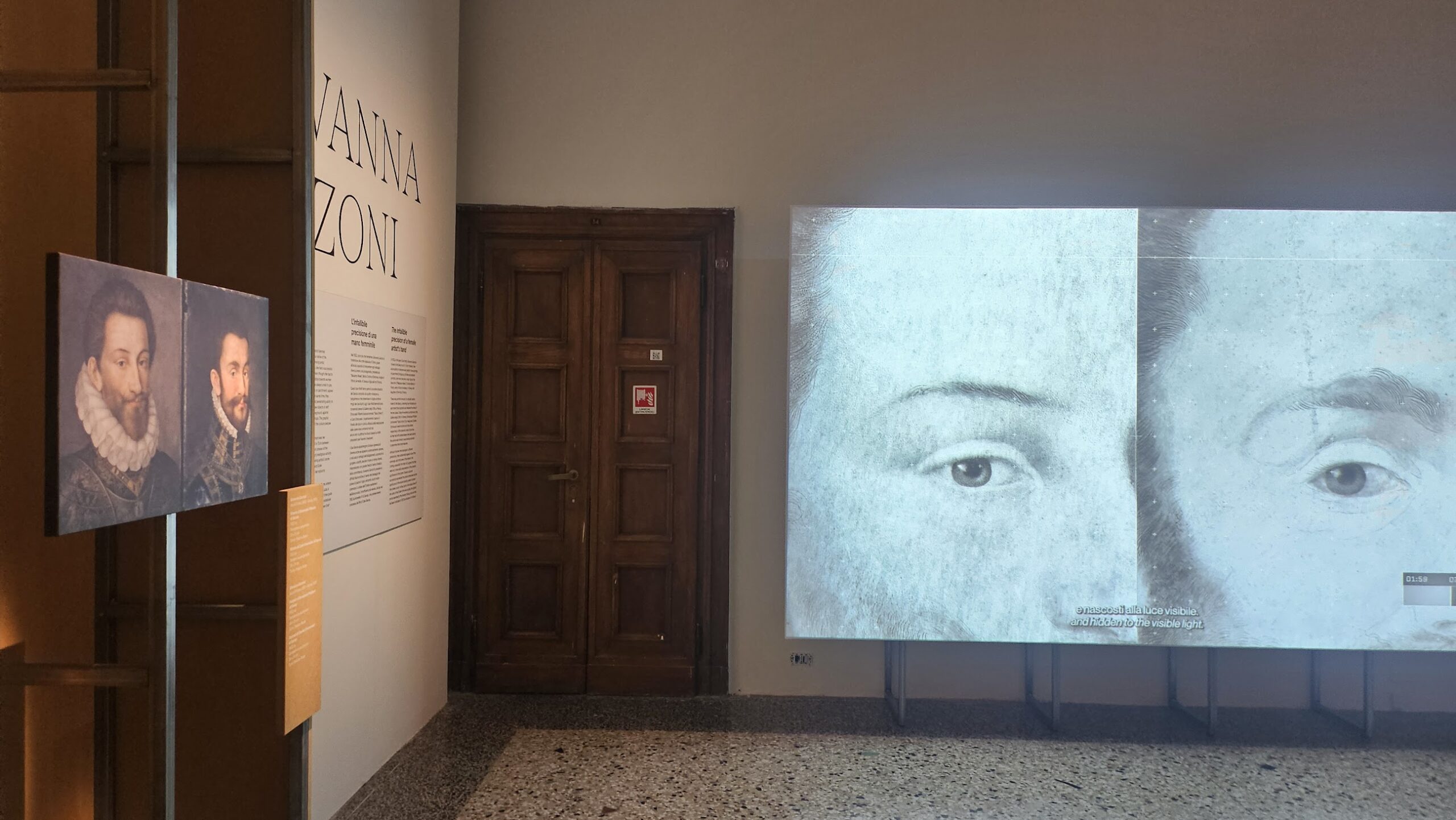
Her Portrait of Emmanuel Philibert of Savoy, painted on parchment, seems at first glance to belong entirely to the realm of the miniature: finely controlled strokes, delicate tonality, an almost tactile attention to light. But beneath that surface lies a world as complex as any oil painting, and it is precisely through diagnostic imaging that we can begin to see the artist’s hand at work.
The use of short-wave infrared reflectance (SWIR) opens a portal beneath the pigment layer, revealing what the human eye cannot: the preparatory drawing. In Garzoni’s portrait, this hidden understructure tells of methodical refinement, adjustment and precision. Each contour of the sitter’s face, each strand of hair or trace of lace, was first conceived in graphite or ink before being softened with translucent layers of tempera.
Unlike traditional infrared, SWIR employs wavelengths capable of penetrating deeper into the medium ( in this case, parchment), and what emerges are faint, spectral outlines that guide us through the painter’s decisions: the shifts in the tilt of a head, the correction of a hand, the subtle tightening of a collar. Far from diminishing the mystery, these traces illuminate it; they make tangible the discipline that underlies the illusion of effortlessness.

Unlike canvas or wood, parchment interacts uniquely with paint. Its organic, slightly translucent nature amplifies the effects of reflected light, lending Garzoni’s works a subtle luminosity that diagnostics now help quantify. Under infrared, one can trace the flow of her brush in ways impossible to perceive under normal viewing conditions. Each highlight, each modulation of tone, becomes a calculated dialogue between pigment, binder, and support.
Through this meticulous craft, Garzoni achieved a balance between precision and intimacy rarely matched in her time. The scientific lens allows us to appreciate not only the perfection of her technique but the persistence of her vision, at the intersection of art, anatomy, and devotion, making the invisible visible with the quiet authority of her hand. By merging aesthetic reading with technical analysis, researchers reveal an artist who was both empiricist and poet, a painter whose control of light rivalled her botanical studies and illuminated manuscripts.
Only one stain: that the curators should feel the need to stress the “precision of the female hand,” as if it’s chromosomal.
4. Caravaggio’s Fortune Teller
Few artists embody the drama of revelation as fully as Caravaggio. His paintings were built on light — violent, sculptural, absolute — and yet what the eye perceives on the surface is only part of the story. The Fortune Teller, one of his early Roman works, hides within its pigments another vision, a ghost image invisible for centuries until modern diagnostics pierced the veil, and you’ll never guess what it is. Through X-ray radiography, science re-enters the chiaroscuro world that Caravaggio himself once mastered, revealing the physical and psychological layers beneath the visible scene.
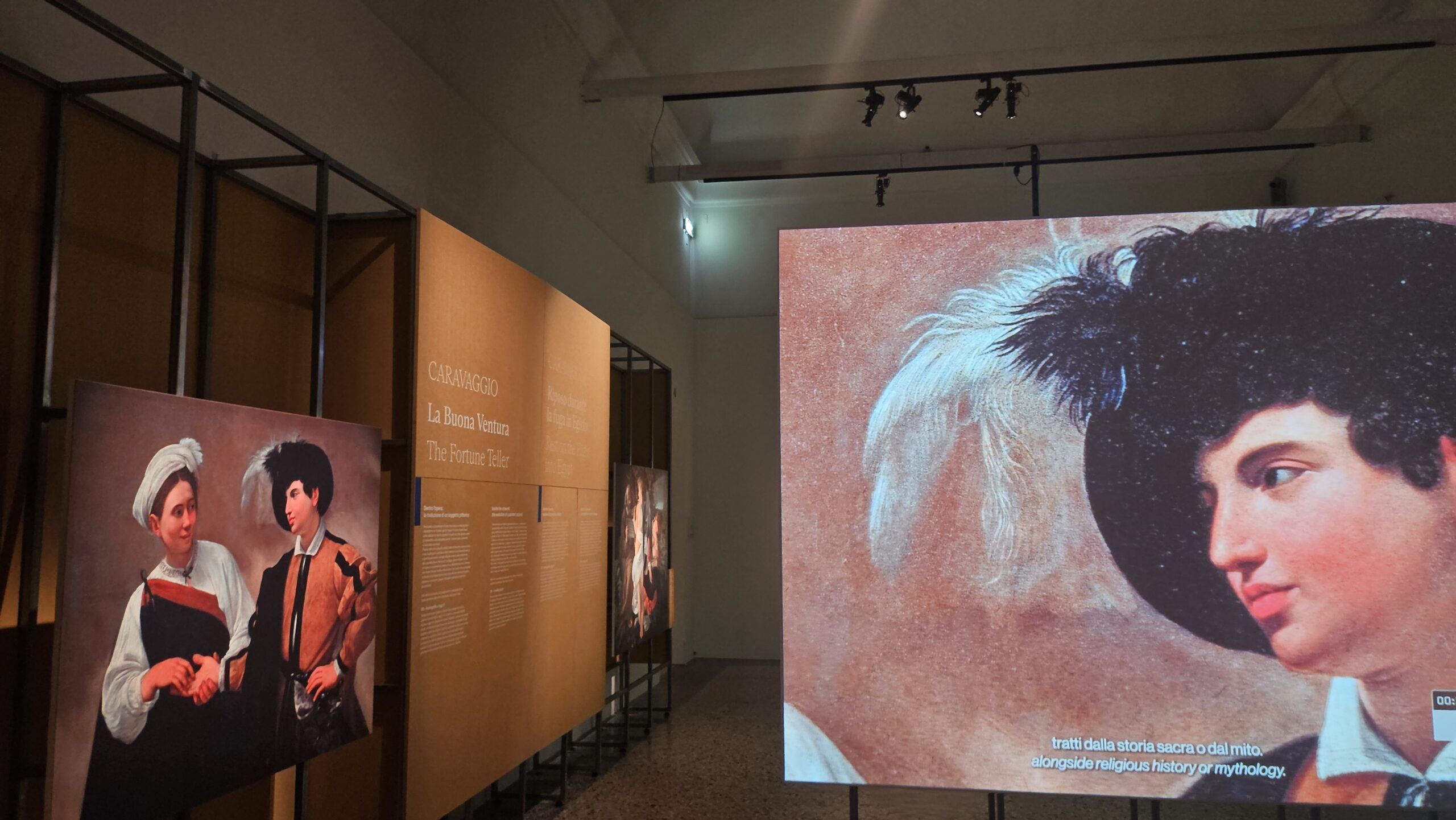
As we have seen, X-rays pass through the work, and denser materials — lead white, vermilion, or metallic pigments — absorb more radiation, leaving bright marks on the resulting image. What emerges is the structure, the skeleton of the composition.
In Caravaggio’s Fortune Teller, that skeleton tells a second story. Beneath the surface depiction of the woman reading a palm lies the faint but unmistakable outline of a Madonna, perhaps an abandoned subject or a repurposed canvas, so we basically have two Caravaggios at the price of one. The discovery redefines our understanding of the work’s genesis, suggesting that Caravaggio may have painted over an earlier religious composition. If you think back into the era, this is a good sign of his revolutionary approach: turning the sacred into the human, the divine into the worldly, and not being afraid to discard an old subject in favour of one that was closer to modern sensibilities.
5. Caravaggio’s Rest on the Flight into Egypt
The second work analysed in this room is another Caravaggio but this time the religious subject persisted: it depicts a small, intimate moment with the Holy family taking a rest during their flight from Herod. Joseph is holding up a musical sheet, in such a way that you can recognise in the melody a Cantico dei Cantici from a Flemish composer, and the other side shows a young Mary holding her baby.
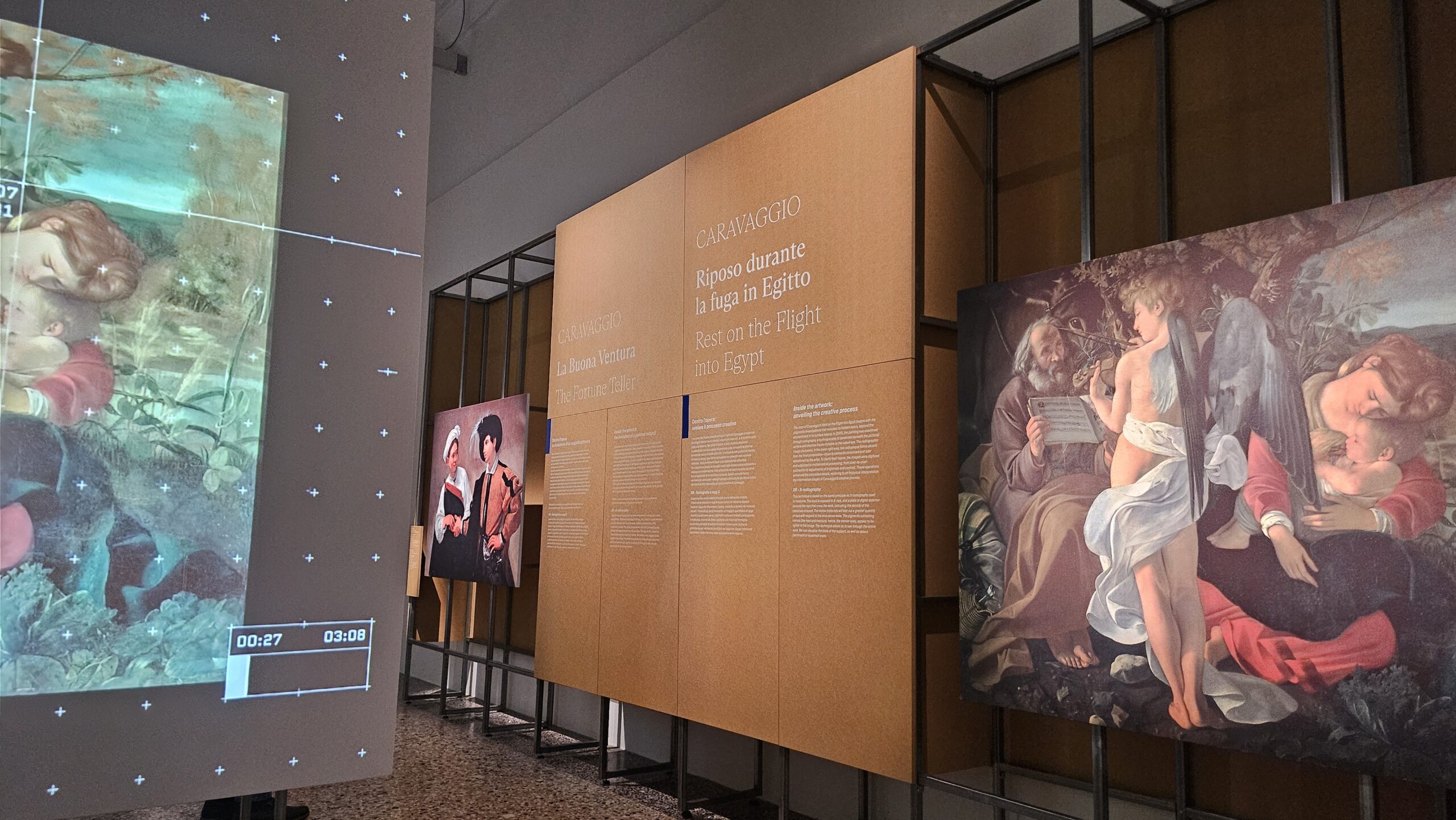
The central figure of an angel, portrayed in the form of a young boy and playing the violin, seems so paramount to the composition that one can hardly believe what the X-ray shows: the angel was an afterthought, a later addition to the painting, and one that makes a world of difference.

6. Boltraffio’s Madonna of the Rose
After Caravaggio’s visceral X-rays, the exhibition turns toward a quieter revelation in lines, symmetries, and reflections. Giovanni Antonio Boltraffio’s Madonna and Child (Madonna of the Rose), one of the finest examples of Leonardesque painting in Milan, invites us into design as conceived within the master’s workshop. What science uncovers here is the architecture of precise geometries and measured adjustments that shaped Boltraffio’s serene vision.

The use of near-infrared reflectance (NIR) allows light to pass through the upper layers of paint, much as if the pigment surface were translucent glass. Beneath, it emerges the delicate network of carbon-based lines that constituted the preparatory drawing to guide the artist’s hand. This is not the impulsive sketching of a late baroque painter, but a deliberate system of planning: measured proportions, controlled curvature, the calculated relationship between gaze and gesture.
It shows us how Boltraffio, a pupil and close collaborator of Leonardo da Vinci, absorbed from his master an obsession with precision, and believed that harmony derived from the close observation of nature. The infrared analysis shows faint outlines beneath the Madonna’s veil and the Christ Child’s profile, along with slight corrections to the placement of the rose that gives the work its name. The preparatory sketch revealed by infrared light marks the moment when the image first came into being, and the NIR analysis allows us to see this fragile stage of conception, the whisper of graphite or charcoal under the luminous paint. It turns the finished painting into a story of layers where composition, proportion, and correction coexist like successive breaths. In Boltraffio’s case, this underdrawing shows us the curvature of the Madonna’s hand adjusted minutely to align with the diagonal of the infant’s arm, and the gaze shifted by a fraction to reinforce the triangular structure linking faces and rose.
Modern diagnostics return us, paradoxically, to the workshop itself. The reflectographic scans mirror the way Leonardo’s circle worked: slowly, iteratively, with layers of reflection built into the process. Just as apprentices once copied and refined their master’s designs through tracing and redrawing, NIR technology retraces their lines centuries later.
7. Pollaiolo’s Young Woman
In one of the final rooms, we find a work that’s very close to the heart of Milan: Portrait of a Young Lady by Piero del Pollaiolo. The wooden panel becomes the true protagonist, its layers of fibre and pigment bearing the silent memory of five centuries. Where earlier rooms revealed hidden drawings or spectral pigments, here the focus shifts to structure: the anatomy of the artwork’s physical body.

The computerised axial tomography (CT scan) enables us to look through the painting: by virtually slicing the panel into hundreds of cross-sections, tomography reconstructs the interior of the wood with its grain, its density, the fine fissures caused by age or environmental stress. In Pollaiolo’s panel, these scans reveal both the resilience and fragility of the material, and the places where the painter’s hand meets the carpenter’s craft. In particular, the hidden architecture behind the refined portrait reveals nail placements to secure the planks, ancient tunnels left by xylophagous insects, fine networks of microcracks that trace the breathing of the wood over centuries.
If tomography probes the depths, optical video microscopy (VM) brings us back to the microcosm of the surface. Under magnification, Pollaiolo’s apparently flawless tempera reveals a world of textures: pigment grains, minute ridges left by the brush, and the hairline cracks that testify to both age and technique. This microscopic scrutiny transforms the delicate contour of the sitter’s face into an almost geological landscape where beauty is inseparable from material endurance.
8. Piero della Francesca’s Nicola da Tolentino
The last piece is another familiar friend, and the only one resident in Milan from the same altarpiece I was talking about in the opening portion of this story: Piero della Francesca’s Saint Nicholas of Tolentino, coming from the Poldi Pezzoli Museum.
Piero’s art has always been a synthesis of intellect and perception. In the Saint Nicholas, non-invasive imaging — combining infrared reflectance (NIR) and short-wave infrared false colour (SWIRC) — reveals the scaffolding behind the stillness. What the eye perceives as an effortless unity of tone and light is, in fact, the result of rigorous construction. Beneath the tempera, the preparatory drawing emerges, revealing adjustments to the saint’s robe, the alignment of his hand, and the modulation of his halo.

I might have been distracted, but I was surprised to see no mention of the diagnostics run on the complete altarpiece, though it’s true that they didn’t involve Saint Nicholas. I’m not sure I want to know the reasons.
In any case, the exhibition is something you cannot miss, and the multimedia apparatus is a marvellous work by another old acquaintance: the same Dot Dot Dot studio who did that Data Bugs installation for the Design Week two years ago. And, talking about that, they opened on Wednesday at the MEET. But that’s a story for another time.




No Comments