
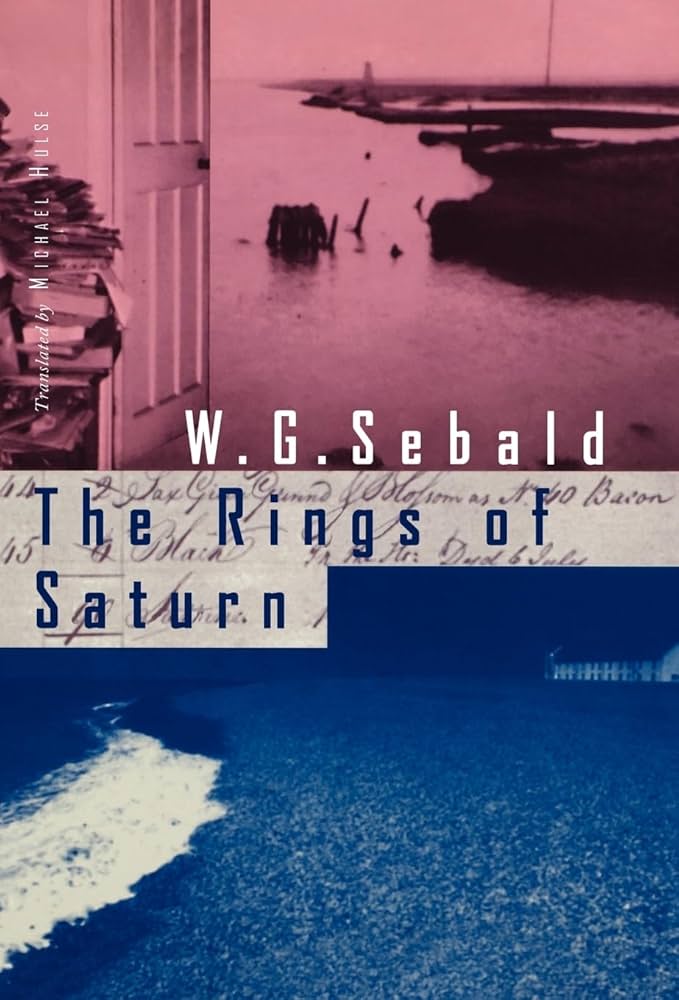
The full German title of today’s book is Die Ringe des Saturn: Eine englische Wallfahrt — “The Rings of Saturn: An English Pilgrimage” — and it was written by W.G. Sebald, a German-born writer, essayist, poet, and literary scholar who lived much of his life in England. He wrote about memory, trauma, exile, and the legacy of the Holocaust in a highly distinctive style that often moves nonlinearly and incorporates photographs and archival material. That mix made him especially influential in late 20th-century and early 21st-century literature. The Rings of Saturn is one of his masterpieces, but what matters here, I think, is what the subtitle conveys.
A pilgrimage has a destination. It’s a path with theological load-bearing capacity: you walk it because something is waiting at the end, a shrine, a relic, an answer proportional to the distance covered. Sebald’s narrator sets out on foot across Suffolk with exactly that vocabulary hovering over the trip and then, deliberately, gives you no shrine. No revelation waits at Dunwich, or Orford, or Southwold. What waits, instead, is more history than any single place should reasonably contain, and a narrator whose walk keeps collapsing sideways into digression about silk manufacturing, herring fleets, Thomas Browne’s skulls, the Taiping Rebellion, a Belgian colonial atrocity a continent away from Suffolk’s flat coastline, until it becomes clear that the actual subject of the pilgrimage was never the towns. It was the fact that the towns kept dissolving into everything that had already happened to them.
This would be enough to earn this book its rightful place in this selection.
The line that belongs on an architect’s desk, though, comes early, when the narrator considers ruins in general and observes that outsize buildings seem to be designed from the first with an eye to their later existence as ruins. It’s an unsettling thought if you spend your working life making drawings that assume, at least on paper, permanence. Every structural calculation is a struggle against collapse. Every specification is a bet against decay (Milan’s Duomo, I’m looking at you). And yet Sebald is pointing at something the eighteenth-century English landscape garden already knew and built follies to prove: that a building’s ruin is not an accident that happens to it later, external to the design, but a phase of the design itself, arriving on schedule, the way a wave arrives having always been implicit in the tide. Dunwich, the town this book keeps circling back to, was once a medieval port to rival London; the sea took nearly all of it, church by church, over six centuries, and what’s left is a walk along a cliff where a knowledgeable local can point at open water and tell you a cathedral used to be there. The town wasn’t destroyed. It was, on Sebald’s terms, simply further along.
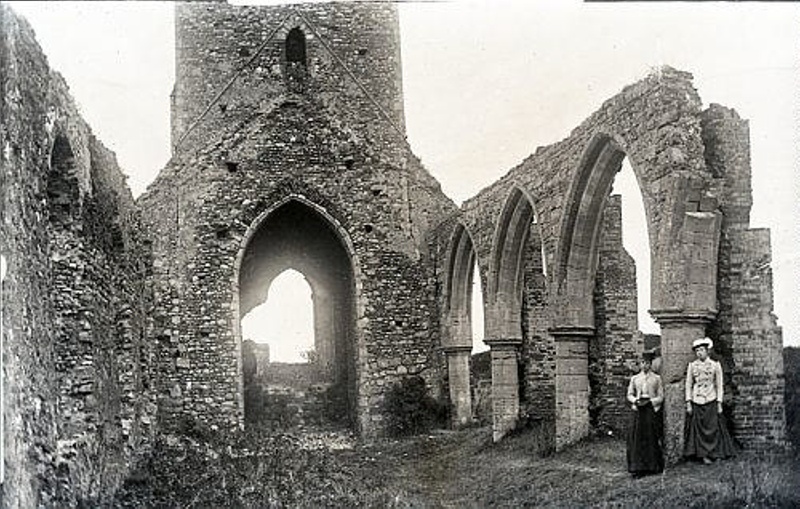
Sebald’s walking is not really movement through space at all, whatever the map would suggest: it’s movement through time, with geography functioning mostly as the excuse to access it. A normal walk is measured in the distance it covered. This one is measured in how many centuries a single field, a single hedge line, a single derelict airfield can be made to hold at once, layered rather than sequential, so that the narrator can be walking past a sugar-beet farm and somehow also be in nineteenth-century China within two paragraphs, with no transition that a conventional travelogue would consider honest. The path, in other words, is not the point: it’s just the pretext that lets the digressions happen in an order that feels like a journey rather than an essay.
We’re trained to research a site’s past mostly instrumentally: soil conditions, prior structures, easements, the practical residue of what came before that might affect what we’re allowed to build now. Sebald’s walk suggests a different relationship to a site’s accumulated time: not research to be resolved before design starts, but a kind of permanent company the design keeps, present in the finished building the way the lost cathedral is present in Dunwich’s empty water, which is to say invisibly, but not actually absent. A site doesn’t stop being everything that has already happened to it just because a new drawing gets laid over the top.



No Comments