
Christopher Alexander was born in Vienna in 1936, to a Catholic father and a Jewish mother, and left with his family for England after the Anschluss in March 1938 (which is a fancy name for when Hitler annexed unwilling Austria to Germany). He read mathematics and architecture at Cambridge, then went to Harvard in 1958 for a doctorate that turned out to be the first PhD in architecture the university had ever awarded: a telling detail, since Alexander spent his whole career treating architecture as something closer to a rigorous, almost mathematical discipline than the purely artistic one some architects are deluded into believing.

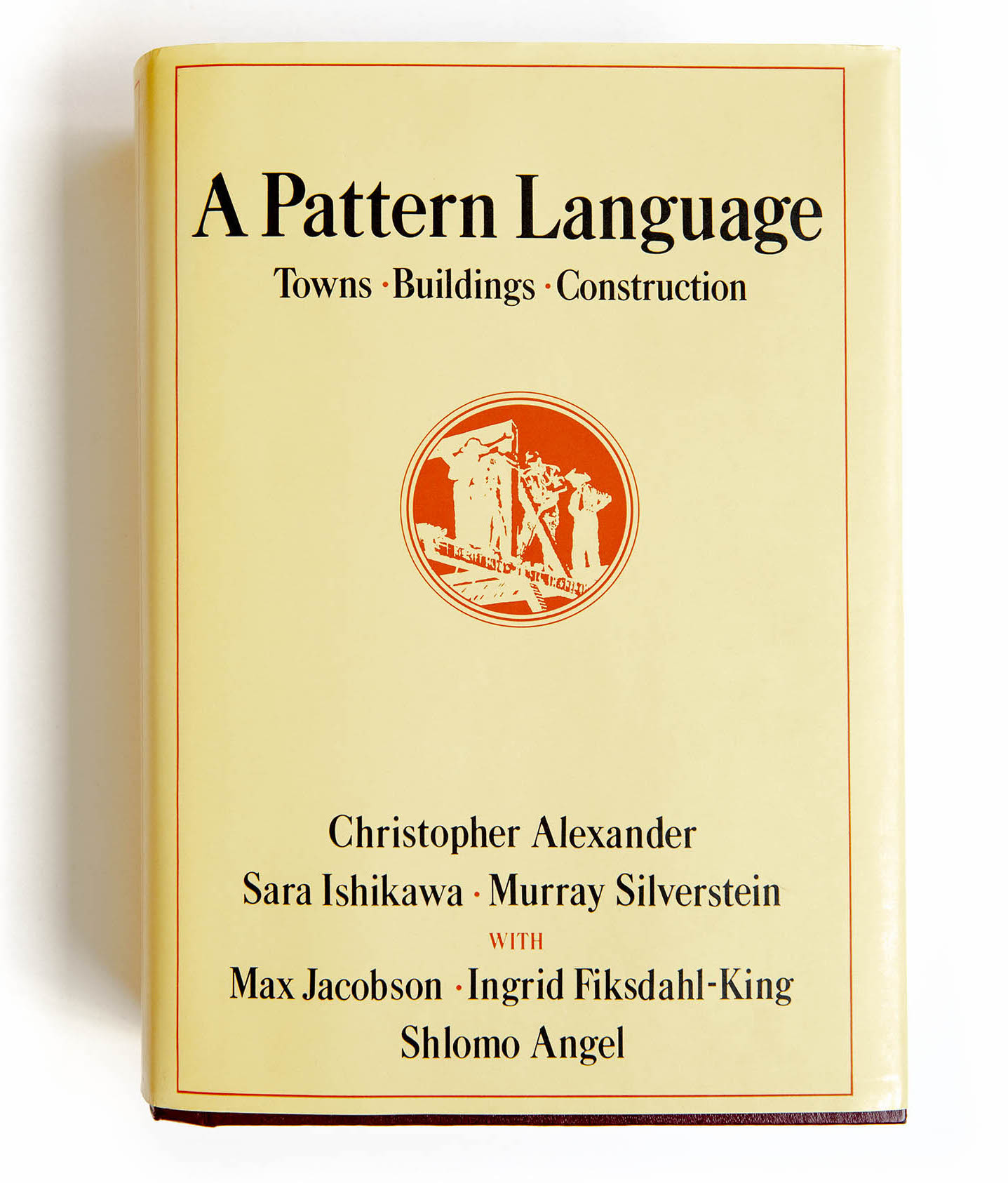
His early book, Notes on the Synthesis of Form (1964), tried to formalise the design process itself as a set of decomposable sub-problems, worked out with the vocabulary of a mathematician rather than a critic. A Pattern Language, published in 1977 with Sara Ishikawa and Murray Silverstein, is the mature descendant of that same instinct: an attempt to write down architecture as a generative system, rule by rule. It is, as much as anything published in the twentieth century, a foundational text for procedural, algorithmic generation of space.
Alexander’s basic unit, the pattern, is a three-part rule: a context, a recurring problem that context produces, and a solution, stated so it can be applied again wherever the same context and problem recur. A porch mediates between a public street and a private house. A room with windows on two walls rather than one answers a specific need. An alcove off a larger room. The book has 253 of these, combinable according to a grammar: each pattern is nested inside larger ones and supports smaller ones. This is, almost note for note, the logical structure later software engineers would borrow wholesale for design-pattern libraries, and that procedural and parametric design tools still lean on today whenever a system generates spatial variation from a constrained rule set rather than a single fixed drawing. Alexander wrote the grammar decades before most of the tools that could actually run it existed.
What makes this more than a very thorough rule set is the claim running underneath it, laid out at greater length in the companion volume, The Timeless Way of Building: that patterns can be alive or dead.
“The specific patterns, out of which a building or a town is made may be alive or dead. To the extent they are alive, they let our inner forces loose, and set us free; but when they are dead they keep us locked in inner conflict.”
Alexander calls the fuller version of this “the quality without a name.”
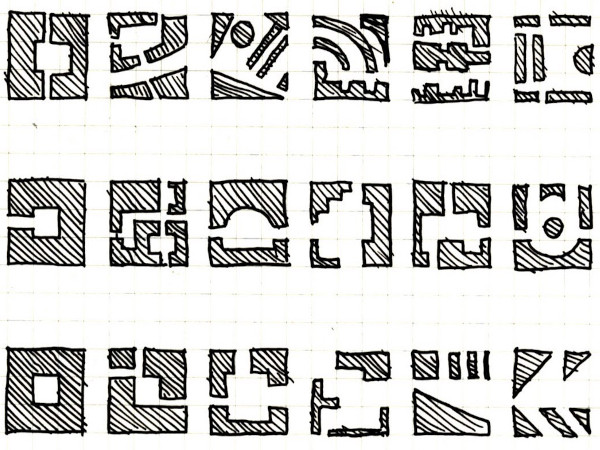
One example that makes this least abstract is a small, almost banal observation about light: “When they have a choice, people will always gravitate to those rooms which have light on two sides, and leave the rooms which are lit only from one side unused and empty.” Two windows instead of one is a formal decision, made for a functional reason, comfort and the particular quality of cross-lit space, but notice what Alexander is actually measuring to prove the pattern is real. Occupancy. People voting with their bodies, choosing the room that works and abandoning the one that doesn’t, regardless of what either room was designed to do. A single-aspect room doesn’t stop being a room because it’s underused: it just becomes, in Alexander’s terms, a dead pattern.
This is the same argument that Alexis Wright and Antonio Machado were making two weeks ago about paths. Wright’s ancestral track exists only because Mozzie Fishman’s convoy keeps singing it and driving it. Alexander is describing the exact same ontology applied to a room instead of a road. On a larger scale, a building isn’t alive because a competent architect once solved its problems correctly on paper, or because a generative rule set produced it correctly: it’s alive to the extent people keep choosing to be in it, the way a path stays a path only by being walked, and that should be the parameter to determine its success. The pattern language gives you the grammar for a room that’s worth choosing — light on two sides rather than one, an alcove that offers real shelter — but the grammar being correct doesn’t animate the room by itself. Occupancy does. A perfectly patterned building that nobody actually uses is, on Alexander’s own terms, no more alive than an ancestral track nobody sings anymore.
This cuts against how form and function usually get talked about in professional shorthand, where function is treated as a fixed, extractable requirement — square metreage, adjacency, egress — that form then obediently serves or willfully ignores, and the job is considered done once the drawing, or the algorithm, satisfies the brief either way. Alexander’s version of function is not that stable or that easily satisfied on paper. It’s closer to a standing invitation the building extends to whoever might live there, and the only real evidence the invitation was accepted is people continuing to say yes to it, day after day, the way a track only stays a track for as long as somebody keeps walking it. Form can support function perfectly, and a generative system can produce a rule-correct result, and the room can still end up dead if nobody ever takes the invitation up.




No Comments