
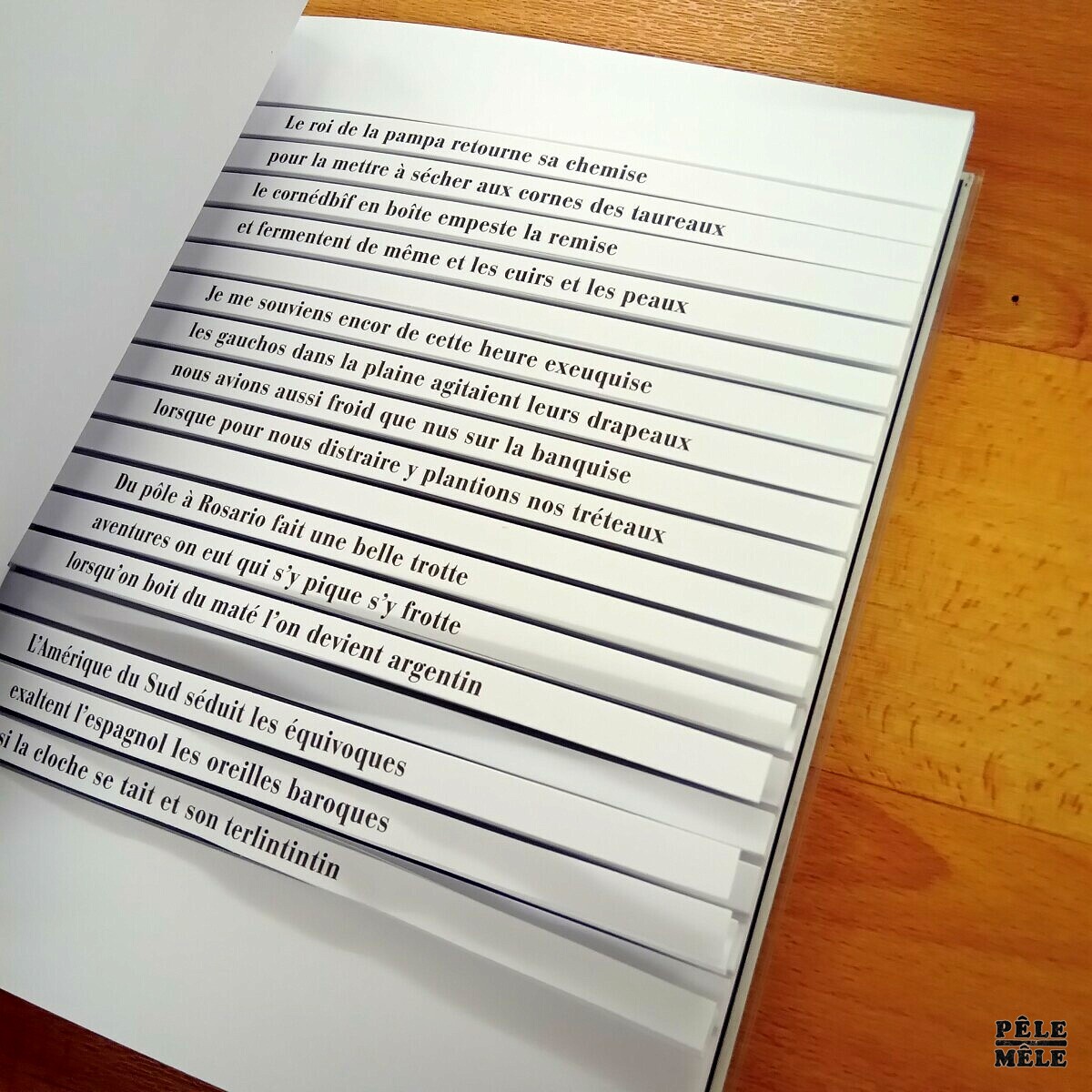
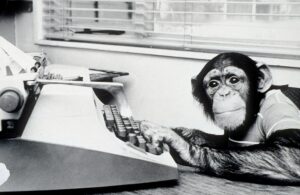
I’m sure you’ve heard it, in some form or another: it’s the famous Infinite Monkey Theorem, and it centres on the idea that, given an infinite amount of time and permutations, a monkey with a typewriter would be able to replicate the works of William Shakespeare. This idea, connected with the behaviour of some artificial intelligence in an Italian essay I recently read, was called ars combinatoria, and has been critiqued by some thinkers in the past, particularly by French author Raymond Queneau, who countered it with an experiment: in his 1961 Cent mille milliards de poèmes (One Hundred Thousand Billion Poems), he crafted 10 sonnets where single line can be swapped with the corresponding line of any other sonnet, and calculated that it would take a human reader about 190 million years of continuous reading to experience every combination. He flipped the script of the Shakespearian monkey by suggesting that a human, using constrained potential literature, could generate a virtually infinite array of high-art poetry almost instantaneously.
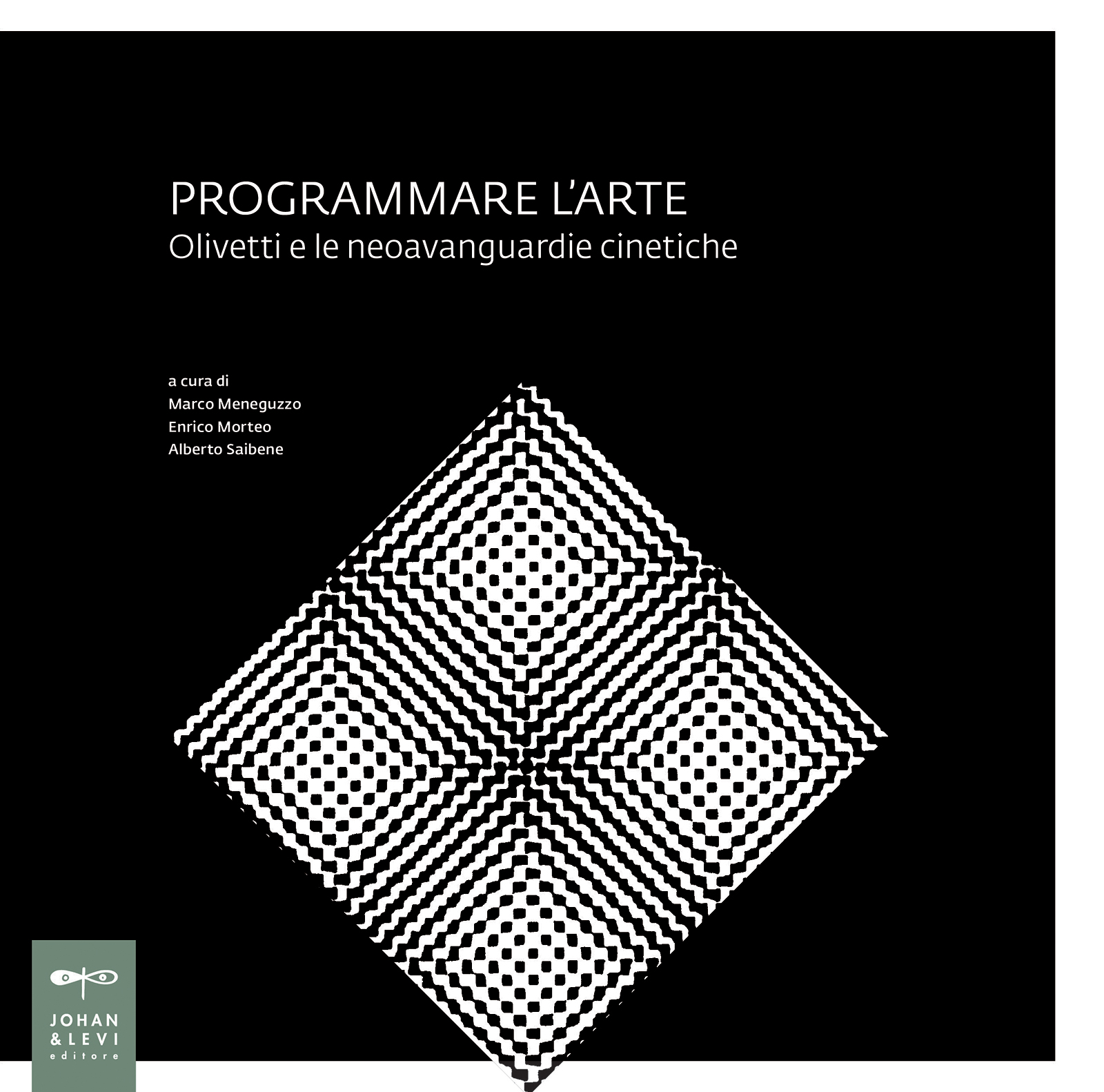
Around 1962, Bruno Munari was doing something similar: he collaborated with Olivetti to create an exhibition called Arte Programmata. Arte cinetica, opere moltiplicate, opera aperta (Programmed Art. Cinetic art, multiplied works, open work), where he constructed his machines through the idea that art could be programmed and left to express itself. The exhibition’s catalogue was curated by Umberto Eco.
I recently thought about this while reading a science fiction short story by Chinese master Cixin Liu (you might know him for The Three-Body Problem). The story is called “Cloud of Poems,” it’s collected in a volume titled Hold Up the Sky, and it’s a loose sequel to another story called “The Devourer,” included in the previous collection The Wandering Earth.
The core of the story is simple: Earth has been subdued by a superior race of aliens who keep humans in farms where they live in harmony and peace, free to be happy and cultivate the arts, until they come of age and they’re slaughtered for their meat. Life sucked anyway, and everyone’s eventually happy with the arrangement. That is until Yi Yi, a teacher, is taken from his farm by ambassador Big-tooth, one of the alien overlords, and taken to an even superior entity, a god in the form of a floating sphere, who’s interested in travelling the cosmos and collecting art. A debate arises, and Yiyi claims not even an all-powerful god could craft poetry that’s superior to Li Bai‘s.
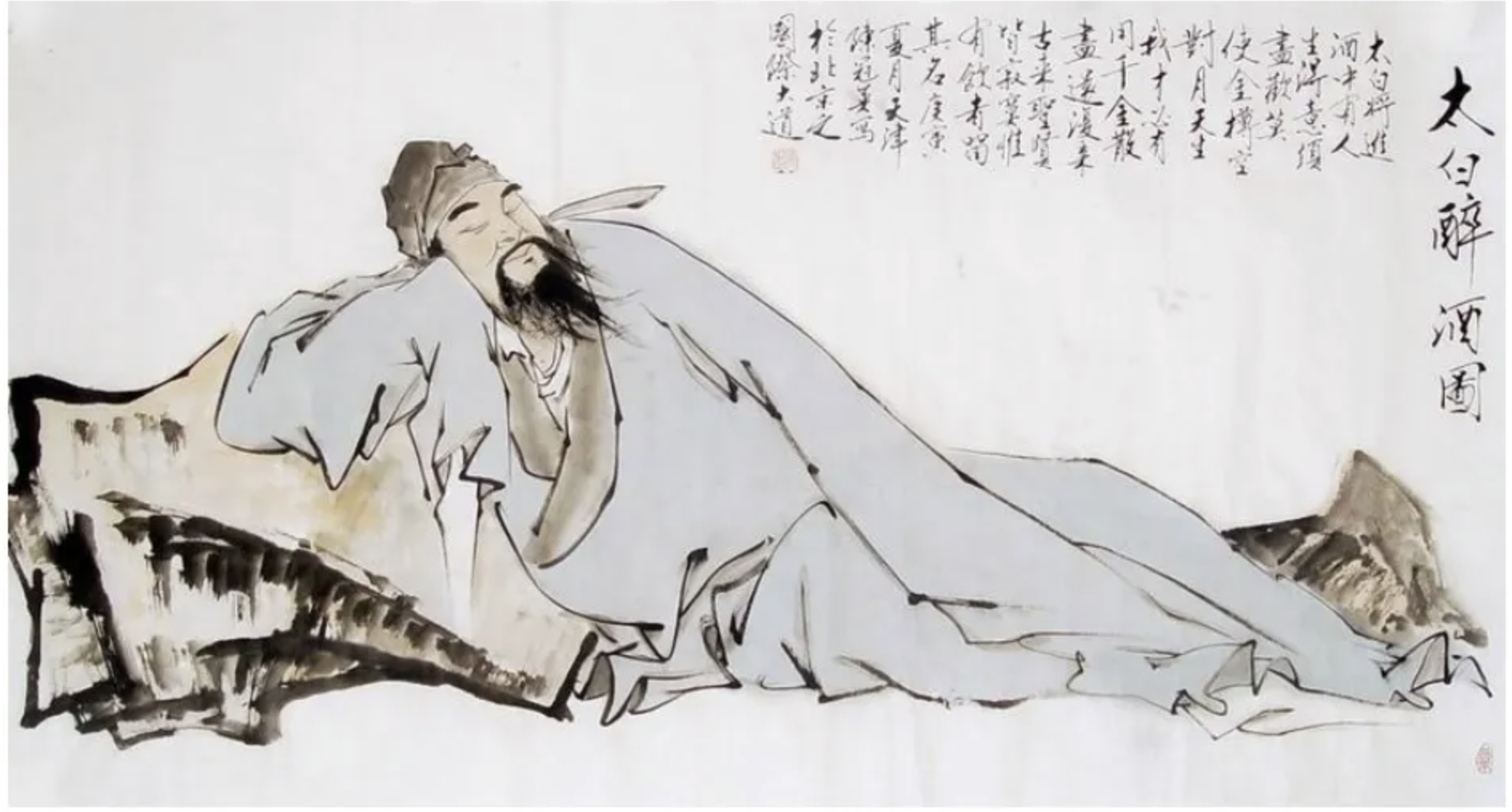
The god steps up to the challenge, turns itself human to experience emotions and flavours (and plum wine), and improves with the incredible quickness of, well, a god, but it still isn’t able to write poetry that surpasses Li Bai. That’s when it gets the idea. All it needs to do is build a supercomputer that’s able to create all possible poems within the strict rules of Tang poetry. It isn’t so far from the Infinite Monkey Theorem. To build such a computer, the god has to devour practically all matter in the universe, thus annihilating it.
Eventually, the machine is complete and starts churning, creating a strip in the sky of all the stored poems, and the god returns to his friend Yi Yi and Big-tooth.
He began to sob. “I’ve failed…”
“How can you say that?” Yi Yi pointed at the Cloud of Poems overhead. “This holds all the possible poems, so of course if holds the poems that surpass Li Bai’s!”
“But I can’t get to them!”
The god met an unsurpassable obstacle: creation is going smoothly (if you don’t consider having destroyed billions of stars to fuel it), but he’s unable to write a poetry recognition software that would point him, amidst the million creations, to the ones that he’s seeking. He wrote them by iteration, but he’s unable to recognise them.
This is the crux of it. The god of “Cloud of Poems” didn’t fail because it couldn’t create: creation, for a being willing to consume the universe, was the trivial part, brute-force, expensive. It failed because it had no way of telling a great poem from a mediocre one, or from noise of nonsense combinations. It had the engine but not the criticism. It had ars combinatoria but not the reader. Yi Yi, a teacher who spent a life closely enough to recognise Li Bai’s transcendence when it drifts overhead, never has to write the poem that surpasses the master: he only has to know one when he sees it. That is the entire, irreplaceable job: recognition.
I think this is exactly where a great deal of the current conversation about generative AI in design goes wrong, and it goes wrong along an axis that has nothing to do with compute, training data, or how many options a piece of software can spit out per minute, and everything to do with a question our discipline used to consider settled: who gets to judge? It started with Munari, it continued with algorithm-based generative design and now, with AI, it exploded.
Every generative tool now sold into architecture and construction — whether it’s parametric option generators, AI massing studies, algorithmic space-planning engines, the various “generative design” features bolted onto authoring platforms — is, structurally, Queneau’s sonnet machine or Munari’s programmed sculpture, scaled up and rebranded. It is very good, often startlingly good, at the combinatorial part: producing hundreds of massing variants that satisfy a floor-area ratio, dozens of structural grids that clear a code envelope, an unreasonable number of façade patterns that all technically work. That problem — variety at scale — is solved, and has been solved, conceptually, since 1961. Nobody needs to be impressed by volume anymore.
What none of these tools do, and what none of them are pretending to do if you read the fine print instead of the marketing, is tell you which of the hundred options is actually good, which one understands the site, respects the section, will still feel generous to a person standing in it in twenty years, or simply won’t fall down in the specific soil conditions of the specific lot. That judgment is Yi Yi’s job, not the god’s. And Yi Yi is only capable of it because he has spent a career reading. Recognising Li Bai is not an innate faculty: it’s disciplinary formation, slow and cumulative.
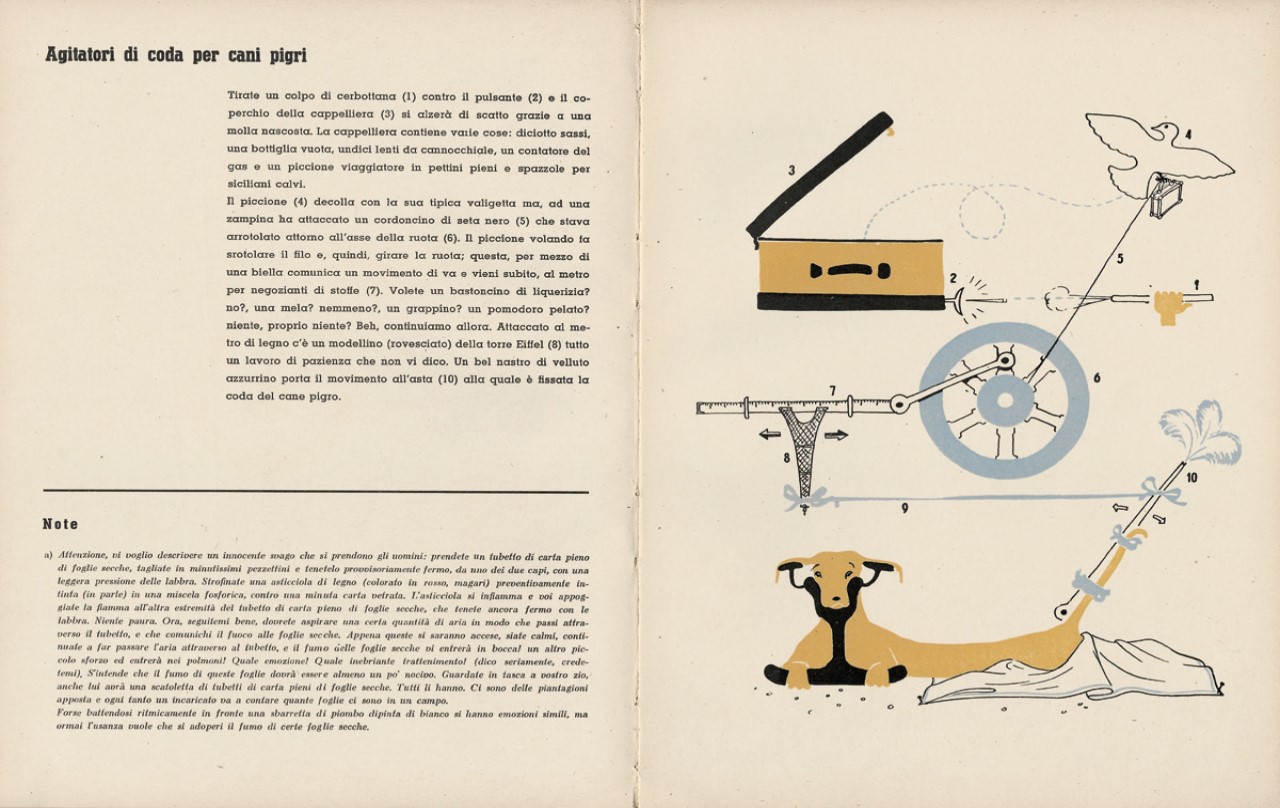
Did you laugh at the machine above? Good, because this is where I get angry: a firm that hands a generative tool to someone without that formation isn’t automating design, it’s replacing Yi Yi with an intermediary who can carry the message but has no basis on which to evaluate it, and who will, when pressed, default to whichever option looks most finished in the render, or whichever one the algorithm ranked first by a metric nobody can interrogate. That is not a hypothetical. It’s the actual failure mode I keep watching happen in offices adopting these tools without also, deliberately, investing in the competence required to use their output critically. The tool generates the Cloud of Poems. Somebody still has to be able to read poetry.


No Comments