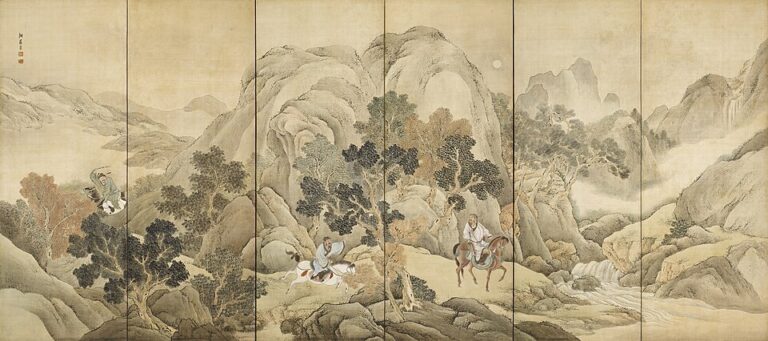
"All this he saw, for one moment breathless and intense, vivid on the morning sky; and still, as he looked, he lived; and still, as he lived, he wondered."

The Tales of Old Miura

The Tales of Old Miura (I racconti del vecchio Miura), published in Italy by Lindau, brings together short stories by Kidō Okamoto (1872–1939), a Japanese playwright and novelist best remembered for his contribution to kabuki theater and historical fiction.

Born in Tokyo during the Meiji era, Okamoto lived through Japan’s transition into modernity. He is best known for his detective fiction The Curious Casebook of Inspector Hanshichi and for Shuzenji Monogatari (The Mask Maker), a kabuki play still performed today, but his wider body of work — including novels, essays, and short stories — explores the conflict between individual desire and social duty.

In The Tales of Old Miura, this theme is distilled into concise episodes that reflect the values and anxieties of early 20th-century Japan. For today’s readers, the appeal lies less in plot than in the cultural insight these stories provide, offering a window into concepts of honor, dignity, and responsibility that shaped Japanese society.

The collection centers on characters undone by their obsessions, most often with art, occasionally with something as trivial as soy sauce. The ideas behind the stories are striking, and the prose is fluid, but the narratives tend to end abruptly, without the dramatic tension or resolution a modern reader might expect. They function less as entertainment and more as literary curiosities, fragments from a cultural world where passion could be both defining and destructive.

This collection is unlikely to satisfy those looking for gripping drama or neatly structured storytelling. Its value lies instead in the perspective it offers on the moral imagination of its time. Kidō Okamoto may not be as celebrated internationally as some of his contemporaries, but his work remains an evocative record of how literature once grappled with the destructive power of obsession.

books and literature

Snow Country

Sometimes you read a book with beautiful prose and well-constructed characters but, when you put it down, you couldn’t tell the plot if your life depended upon it. Kawabata Yasunari‘s Snow Country is one of these books. Born in 1899, the author won the Nobel

Read More »
books and literature

War and Peace

I’m satisfied.Satisfied and surprised.Satisfied because this book, since reading the Peanuts as a child, is the Ultimate Achievement. Once you’ve read it, you feel you can achieve everything. You could even be the first beagle to land on the moon.And satisfied because… by God, this

Read More »
architecture, engineering and construction

A New Vision for the Learning Crisis

The end of 2024 brought us no grand educational reckoning, no moment of consensus that we need to reimagine how adults learn. Instead, through 2025, we’ve settled into a peculiarly quiet collective exhaustion with the pandemic’s educational experiments, paired with a creeping anxiety that something

Read More »
Share on LinkedIn
Throw on Reddit
Roll on Tumblr
Mail it
No Comments

Post A Comment

This site uses Akismet to reduce spam. Learn how your comment data is processed.

RELATED POSTS

Snow Country

Sometimes you read a book with beautiful prose and well-constructed characters but, when you put it down, you couldn’t tell the plot if your life depended upon it. Kawabata Yasunari‘s Snow Country is one of these books. Born in 1899, the author won the Nobel

Read More

War and Peace

I’m satisfied.Satisfied and surprised.Satisfied because this book, since reading the Peanuts as a child, is the Ultimate Achievement. Once you’ve read it, you feel you can achieve everything. You could even be the first beagle to land on the moon.And satisfied because… by God, this

Read More

A New Vision for the Learning Crisis

The end of 2024 brought us no grand educational reckoning, no moment of consensus that we need to reimagine how adults learn. Instead, through 2025, we’ve settled into a peculiarly quiet collective exhaustion with the pandemic’s educational experiments, paired with a creeping anxiety that something

Read More