
— The following review contains heavy spoilers on Liu Cixin’s first novel in the Remembrance of Earth’s Past trilogy: The Three-Body Problem. Proceed with caution —
The first time I opened The Three-Body Problem, I didn’t quite realise I was stepping into a new dimension of science fiction. I expected complexity, of course, since lots of people are describing it as “hard sci-fi”, and that means equations, paradoxes, perhaps some elegant thought experiments about alien civilisations. All that jazz. What I didn’t expect was the profound sense of vertigo that followed, the feeling of standing at the edge of a cosmic abyss where human history, science, and morality dissolve under the weight of an indifferent universe. Liu Cixin doesn’t just write about another world, but he writes as if our own has already become one, estranged from meaning and suspended in the void of its own contradictions.
What struck me most wasn’t only the scale of the ideas, but their specific gravity, and the way they drag the reader down into both wonder and unease much like the immersive, virtual reality videogame featured in the novel itself. This is a work where the laws of physics are weaponised, where the speed of thought can determine the survival of a species, and where even the simplest question — “Are we alone?” — becomes an existential trap. Liu’s imagination is not only vast but structured: every speculation is bound to rigorous logic, to the same cold precision that governs the orbits of his three suns on the doomed alien planet. In this sense, The Three-Body Problem doesn’t just reinvent first-contact fiction but reframes it as a mathematical tragedy, where beauty and terror are indistinguishable.
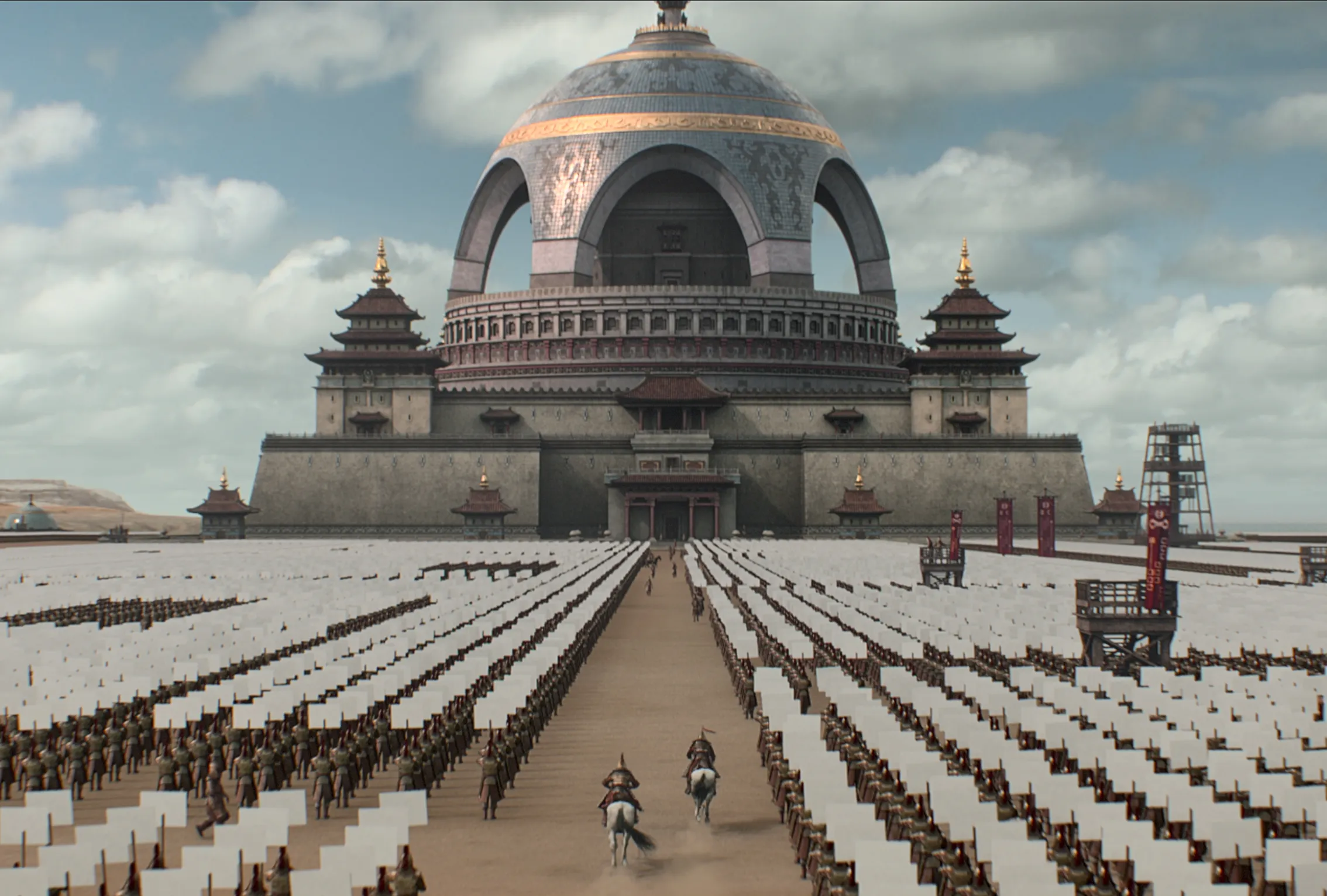
Placed within the tradition of science fiction, Liu’s work occupies an unusual position. It emerges from a cultural and historical context that Western readers rarely glimpse: a China shaped by the fervour and trauma of the Cultural Revolution, yet also driven by an almost Promethean fascination with progress. Where Western sci-fi has often mirrored the anxieties of capitalism, colonisation, or the Cold War, The Three-Body Problem speaks to the fragility of scientific truth under political violence, and the precarious faith in knowledge itself. It is, at once, an epic of ideas and a lament for those who dared to think. The universe of The Three-Body Problem is not a playground for human curiosity but an arena of survival where intellect itself becomes a liability.
In the broader landscape of global science fiction, Liu’s novel feels like a seismic event at which the genre’s traditional Western axis begins to shift eastward. It carries echoes of Clarke’s cosmic mysticism, Asimov’s rational grandeur, Lem’s metaphysical riddles; yet it speaks in a distinctly Chinese voice, one attuned to cycles of upheaval, endurance, and rebirth.
To go through this novel, then, is to experience the shock of scale, not just spatial or temporal, but moral. It reminds us that humanity’s greatest achievements may be irrelevant in the grand equation of the cosmos. And yet, paradoxically, that realisation is what makes Liu’s universe so hauntingly beautiful: we stare into the dark, and for a moment, the dark stares back with malice. And in that malice, we find the measure of our own fragile brilliance.
1. Conception
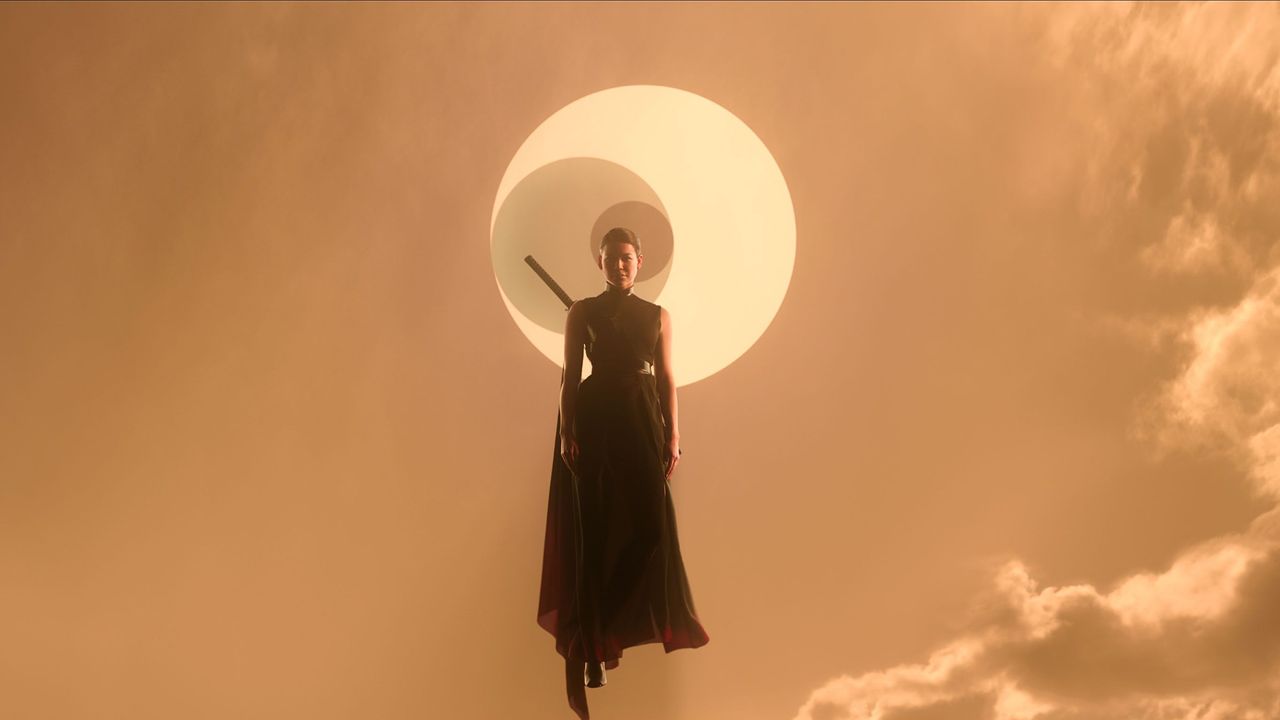
At its core, The Three-Body Problem is built around a well-known scientific impossibility — a planet caught within a system of three suns follows an orbit that cannot — the titular problem in classical mechanics. This scientific prompt becomes, under Liu Cixin’s hand, a way to talk about the instability and stubborn endurance of civilisations, ideologies, and even reason itself. It is this synthesis — between mathematical abstraction and historical trauma — that makes the novel not just innovative, but profoundly unsettling.
Liu’s narrative moves with a kind of fractal precision: each part of the story mirrors the others at different scales. On one level, we witness the Cultural Revolution, where human society oscillates between order and catastrophe, just as the Trisolaran world is periodically annihilated by its suns. On another, we see individuals — scientists, soldiers, bureaucrats — caught in their own orbits of belief and betrayal, seeking equilibrium where none can exist. The structure itself is nonlinear but cumulative: what begins as a story of mysterious suicides in the scientific community slowly unfolds into a cosmological revelation.
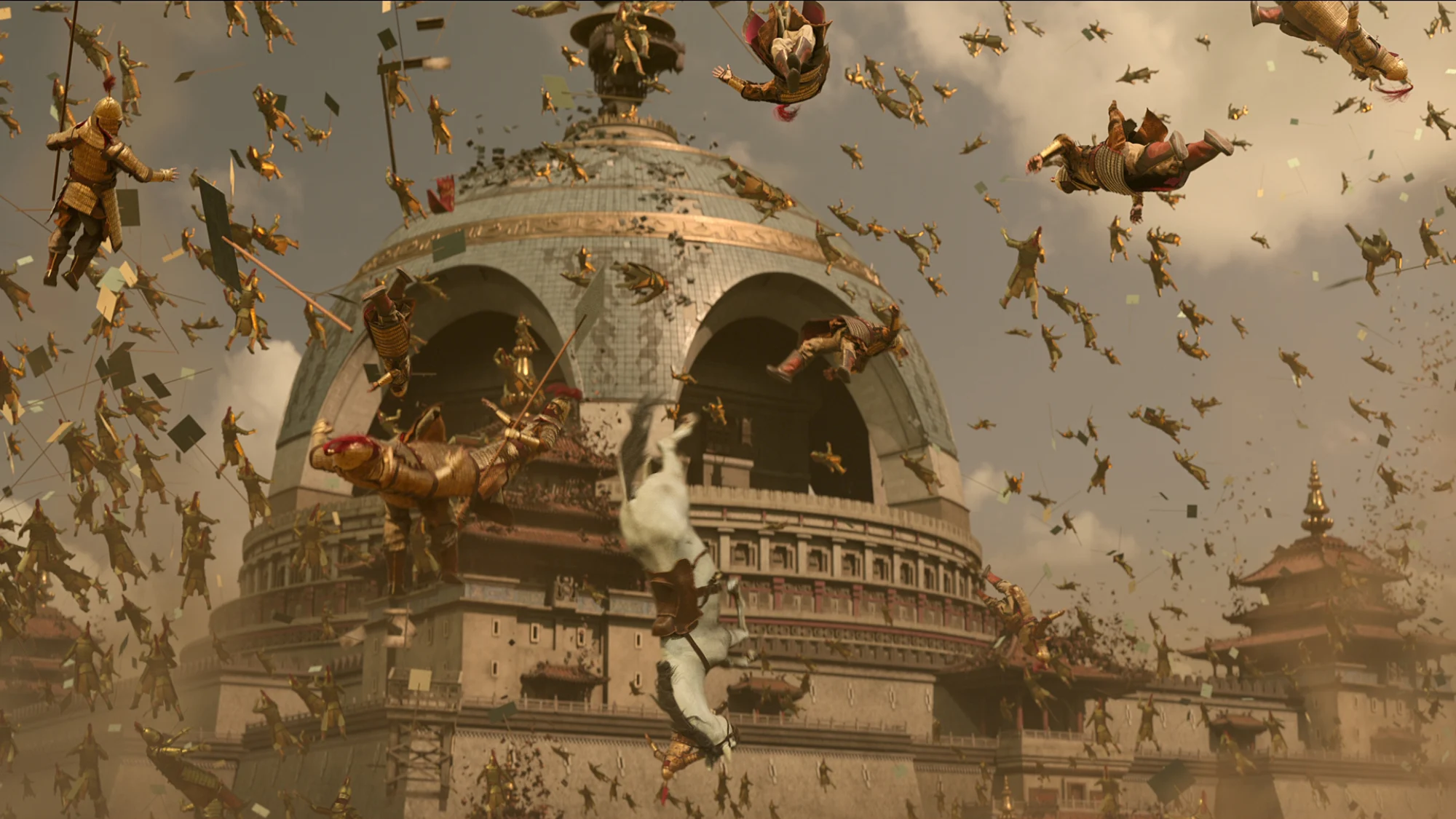
Liu’s innovation lies in how he builds epistemology into plot. Every revelation in the novel feels earned through the process of reasoning, yet the conclusions it leads to are metaphysically devastating. He uses the conventions of hard science fiction — detailed physics, computer simulations, and thought experiments — not as ornament but as moral architecture. The virtual world of the Trisolaran game, for instance, becomes a crucible for the reader’s comprehension: a simulation that gradually ceases to be fictional within the fiction, a mirror in which the general plot is exposed and the point shifts from solving the problem to accepting that the problem can’t be solved. Even if perhaps it can.
Liu Cixin is often praised for his audacity, but what deserves equal recognition is his discipline. The pacing of the novel alternates between extreme compression and vast dilation; moments of intimate human despair are followed by centuries of cosmic evolution on the foreign planet. This rhythm mimics the novel’s thematic tension between human finitude and universal immensity. The result is an aesthetic that feels almost geological: human emotions are sedimented beneath layers of theory, technology, and history, yet they remain the strata that give meaning to everything above them.
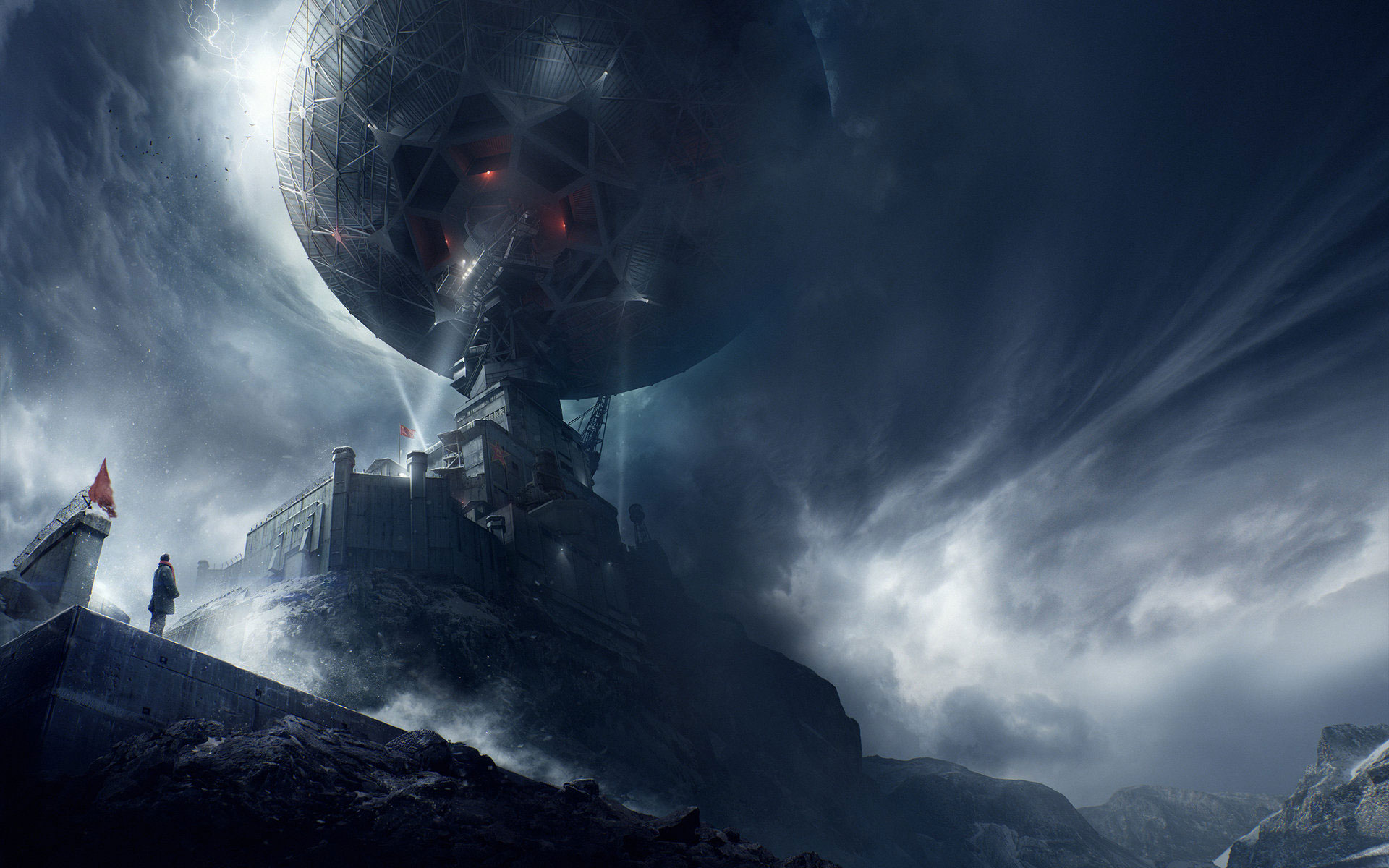
The conception of The Three-Body Problem is thus not merely innovative in content, but in form as it bridges two intellectual traditions: the rationalism of scientific inquiry and the fatalism of historical cycles. Where Western hard sci-fi often isolates the scientist as a heroic figure, Liu portrays science as both salvation and curse, a force that might illuminate but also invite annihilation. The very act of understanding the universe becomes dangerous, as Ye Wenjie’s tragic trajectory illustrates. Knowledge is power as much as it is exposure.
This duality — that the pursuit of truth might invite destruction — gives the novel its enduring tension. It transforms scientific speculation into existential horror while still maintaining the elegance of intellectual rigour and achieves something that few science fiction writers dare: it treats science as destiny, not as a tool, and by doing so, it places humanity not at the centre of the universe but simply within its equations.
2. Science, Destruction, and the Cultural Revolution
If The Three-Body Problem begins as a meditation on science, it soon becomes an anatomy of intellectual, moral, and cosmic destruction. In this, the Cultural Revolution which opens the novel isn’t merely a historical setting but primal scene from which all other tragedies radiate. Liu Cixin stages that era of persecution — when scientists were humiliated, executed, or driven to despair — as both metaphor and mechanism: the self-inflicted wound of a civilisation that has turned against its own curiosity. And this, crucially, mirrors the novel’s other act of annihilation — SPOILER ALERT — as the Trisolaran campaign to eradicate humanity. A war of extermination similarly justified by fear of unpredictability, of chaos, of the unknown.
At the centre of both narratives is the destruction of science itself. In the opening chapters, we watch as Ye Zhetai, a physicist, is beaten to death for teaching relativity and his daughter Ye Wenjie is forced to witness the spectacle. This moment marks more than a personal trauma that will guide Ye’s actions further down the novel: it showcases the death of intellectual freedom, the collapse of rational inquiry under ideological gravity. Decades later, when Ye Wenjie makes contact with the Trisolarans, she sees in them not monsters, but as a solution to what humanity has become while, in fact, they’re a reflection. Partially without her knowledge, the aliens’ authoritarian drive for stability and their willingness to erase all unpredictable life echoes precisely the mindset of the Red Guards: order through destruction, purity through annihilation.
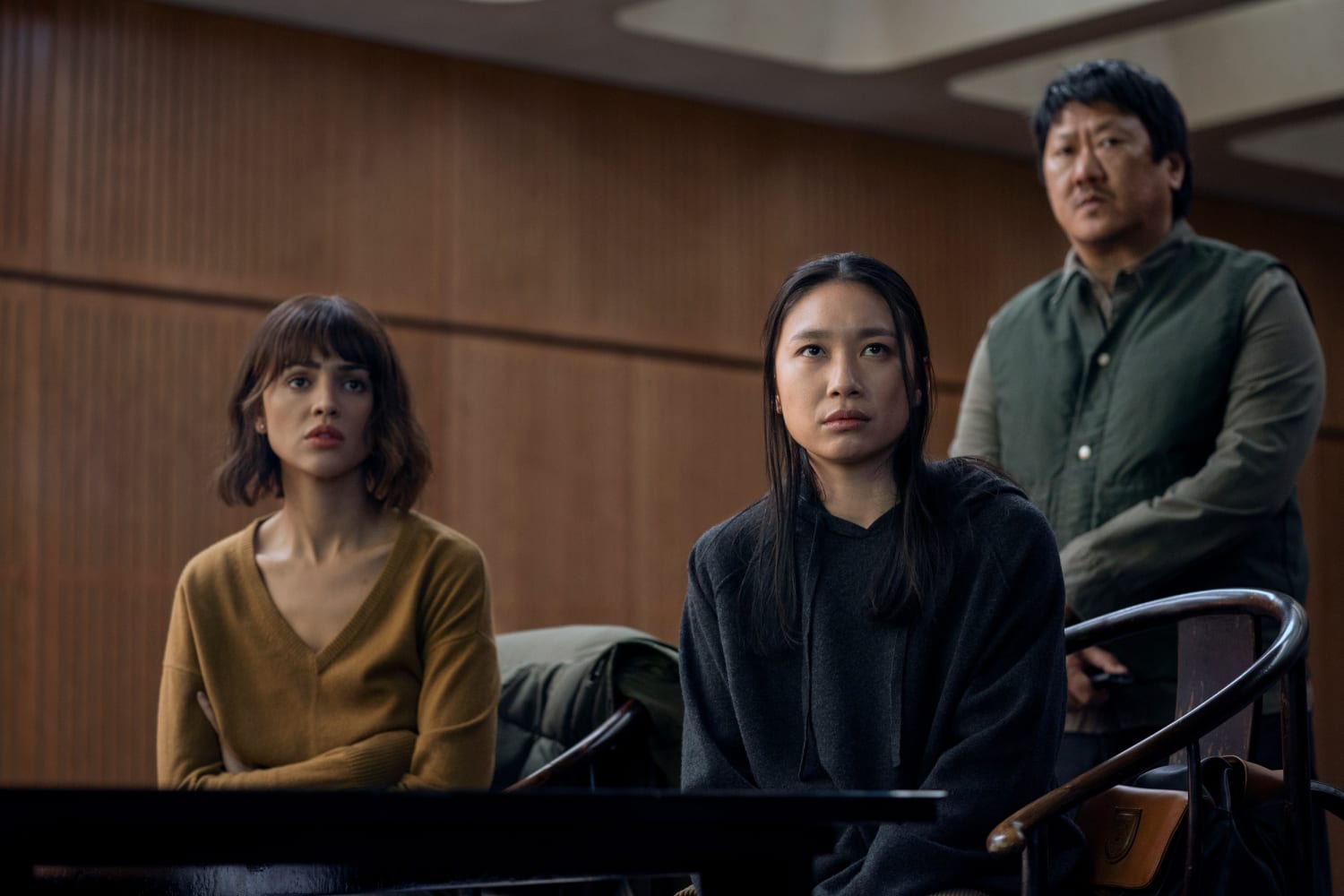
Liu constructs a double symmetry between Earth and Trisolaris: on both worlds, knowledge is both salvation and curse. On Earth, scientific progress leads to political persecution and ecological ruin; on Trisolaris, it breeds control so absolute that individuality has vanished. Ye’s decision to signal the aliens is an act of disillusionment: she has witnessed human brutality and concludes that a more advanced species must be more rational, more humane. But in doing so, she repeats the fatal logic of her persecutors: the belief that reason can justify erasure.
This parallel extends even further. The chaotic motion of the three suns that repeatedly destroys Trisolaran civilisation mirrors the chaos of human political revolutions: unpredictable, cyclic, and total. Each “Stable Era” on Trisolaris is a fragile illusion, as brief as any political consensus. And each “Chaotic Era” is apocalypse reborn. Liu’s genius lies in using this astronomical problem as a political allegory: history, like the cosmos, has no stable solution and civilisations swing between extremes not because they are irrational, but because instability is the only constant.
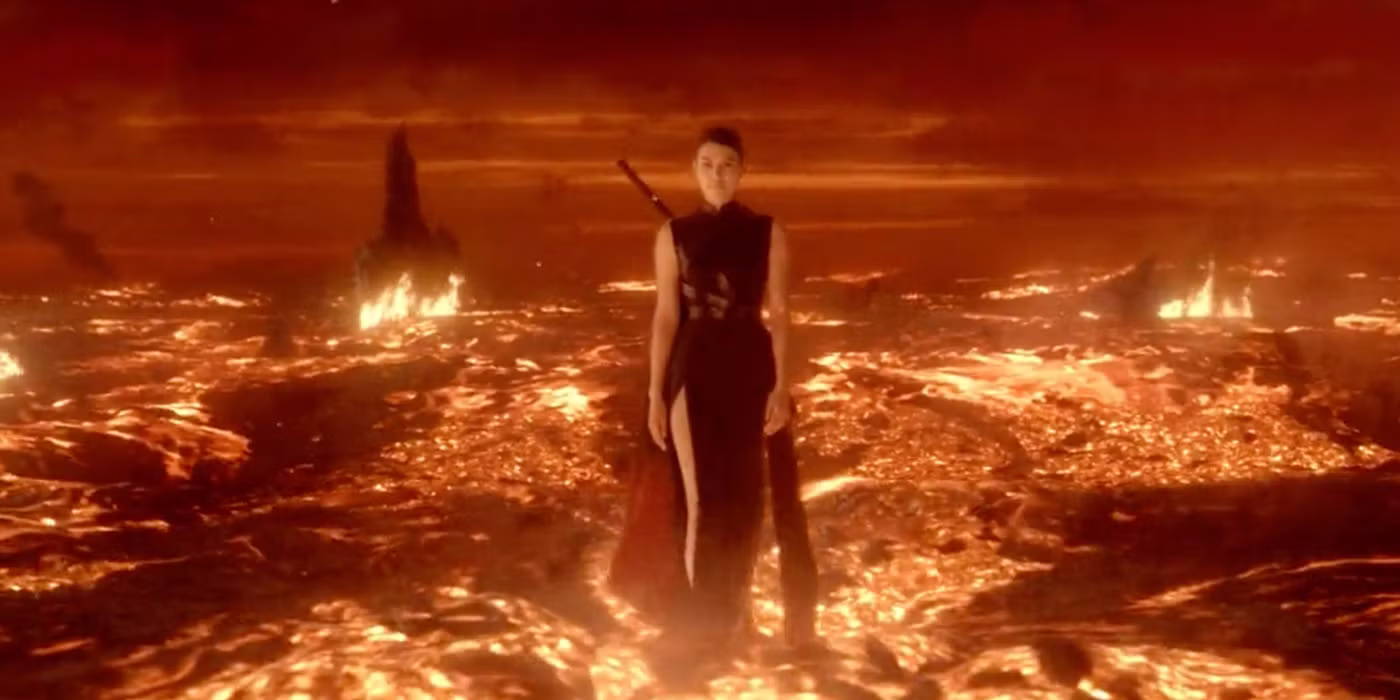
The resonance deepens through the novel’s human characters, who inhabit different phases of this cycle. Ye Wenjie represents the scientist disillusioned by history, turning her intellect inward, toward fatal abstraction. The scientists of the present era — Ding Yi, Wang Miao — represent a generation that inherits this wound without understanding it, still believing in the purity of discovery while the world around them commodifies and manipulates science. And finally, Shi Qiang — the gruff, instinctive detective — embodies the counterforce to intellectual despair, the earthy pragmatism that refuses to surrender to either ideology or theory. In a way, he is the antidote to Ye Wenjie: where she loses faith in humanity’s capacity for meaning, he stubbornly restores it.
In this constellation of characters that’s relatively small compared to the series (more on that later), Liu builds a human model of the three-body problem itself: the scientists (like Ye and Wang) chase perfect equations, the pragmatists (like Shi) anchor them to the messy gravity of reality, and between them lies chaos, misunderstanding, mistrust, annihilation. The same dynamic that destabilises a planet pulled by different stars destabilises societies: ideas attract and repel, collide and scatter, until catastrophe resets the system. Could this catastrophe be the announcement of an imminent alien invasion?
The very same humanity that Ye Wenjie condemns for its cruelty becomes, later in the trilogy, the civilisation that fights most fiercely for survival, innovation, and memory. The aliens who seemed rational become slaves to their own fear. In both cases, the will to survive leads to destruction, and the paradox defines both species.
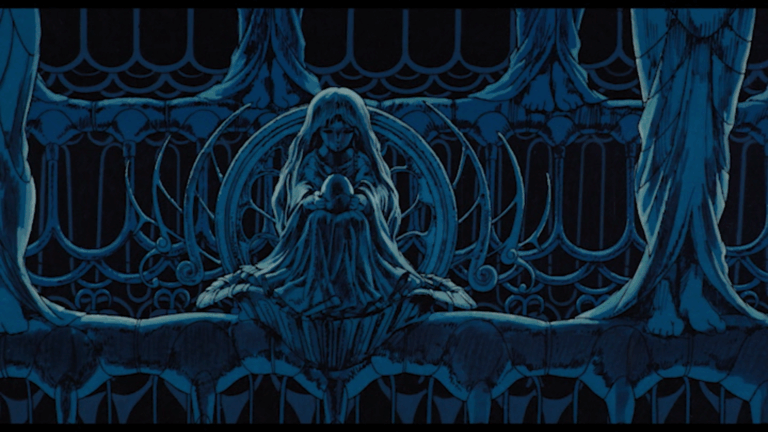
Up to this point, all pictures were from the Netflix Tv series. Below, the Graphic novel illustrated by XuDong Cai.
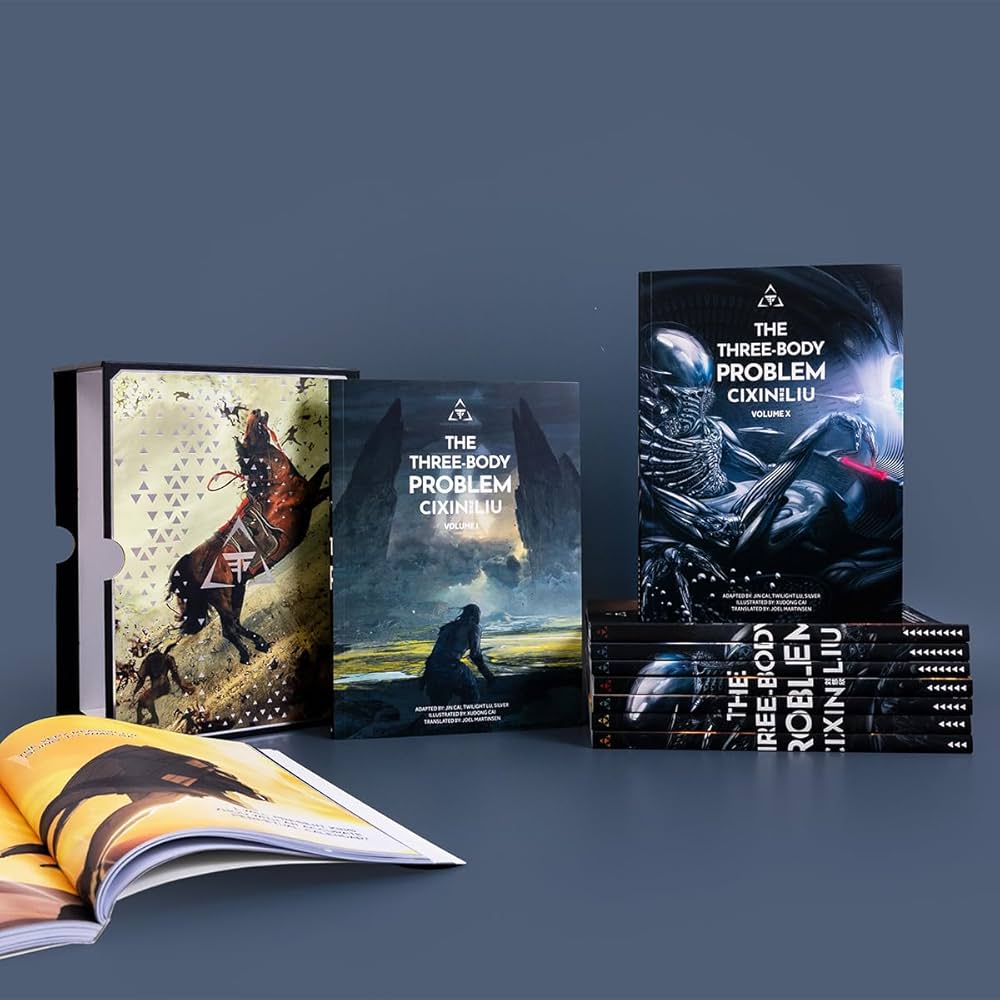
1 Comment
Pingback:Shelidon | The Wandering Earth
Posted at 09:00h, 08 March[…] Problem. Some stories will remind you of some plot tricks you’ll also see in The Three-Body Problem and The Dark Forest: space wars carried out by throwing satellites against spaceships, stellar […]