
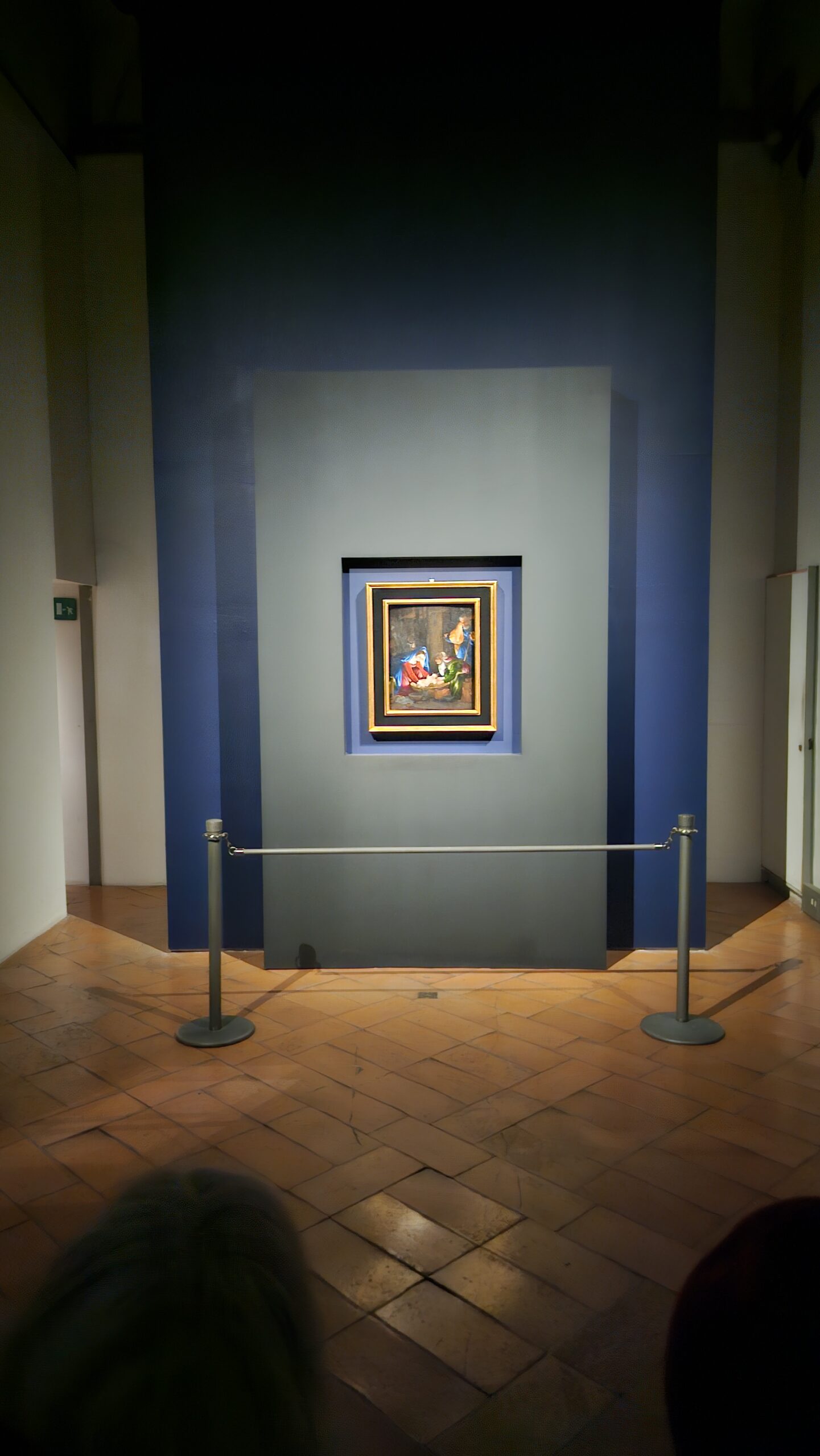
As usual for Easter and Christmas, the nearby church of Saint Eustorgio makes an effort to borrow a single masterpiece from someone, and then explains the shit out of it through a dedicated installation. This Christmas, it’s the time of a Nativity by Lorenzo Lotto, a particular one because it features a character from the apocryphal Gospel.
The Painting
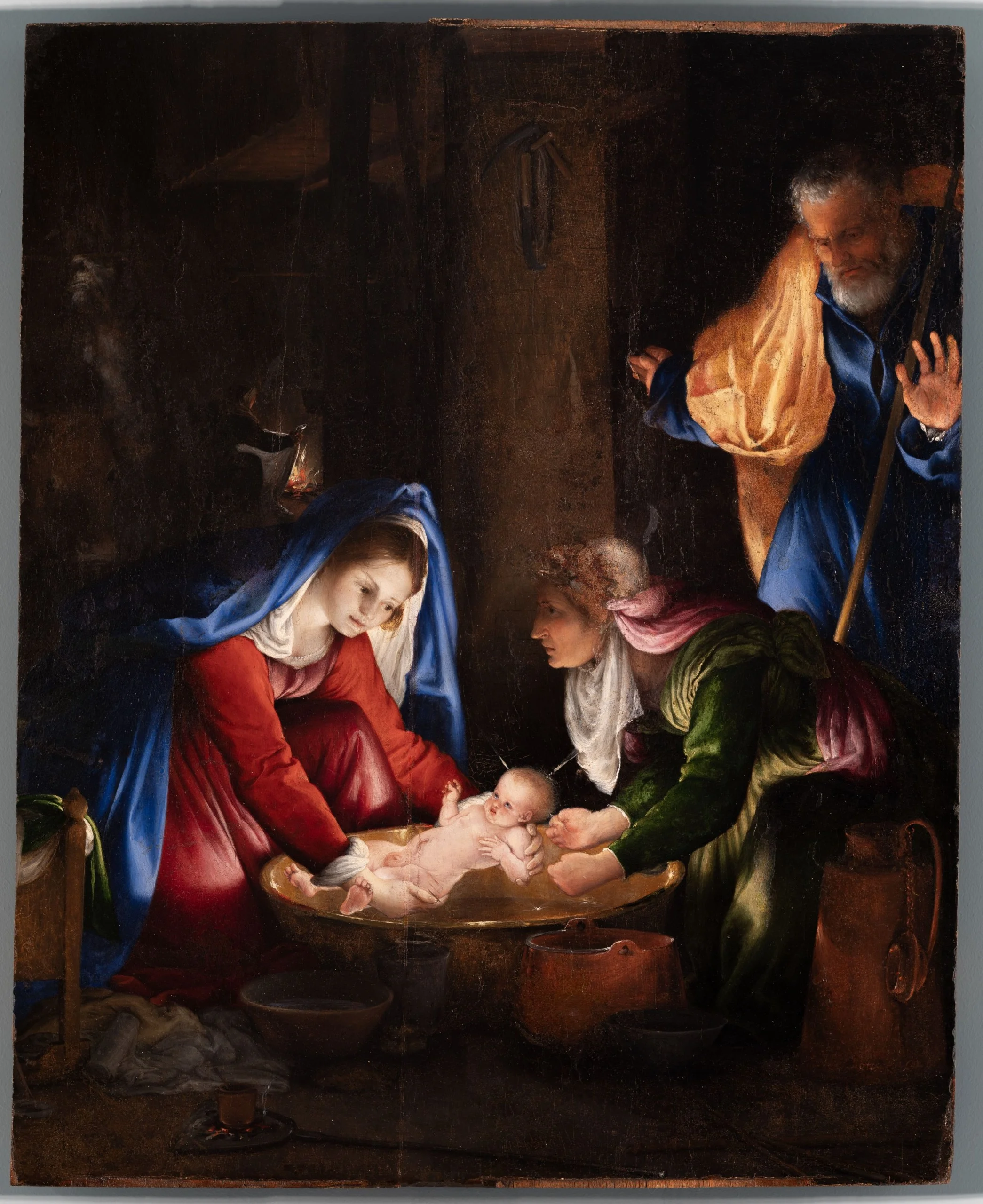
This painting represents the Nativity through an unusually intimate and domestic interpretation, attributed to Lorenzo Lotto and datable to the early 16th century. Originally part of the Gonzaga collection in Mantua, the work was dispersed after the Sack of Mantua in 1630 and later entered the Spannocchi collection before being donated to the Pinacoteca Nazionale di Siena, where it resurfaced in the 20th century.
Unlike many traditional Nativity scenes, the composition includes an elderly midwife in the foreground. The setting is a humble, nocturnal stable, rendered with striking realism down to the details of the brass pan and the sheets being boiled. Lotto demonstrates his mastery of light by orchestrating two distinct light sources: the divine glow emanating from the Child, reflected on the faces of Mary and the midwife, and the warmer, earthly light of a fire in the background, where another woman dries linens.
This dual illumination enhances the divine and human dimensions of the scene: the Virgin’s tender concentration on the Child contrasts with Joseph’s astonished gesture and the midwife’s wonder, creating a network of glances that reinforces the painting’s emotional cohesion. The everyday objects present in the scene — wooden tools, hanging cloths, domestic furnishings — anchor the sacred event in lived reality, and they’re a hallmark of Lotto’s approach.
The colours, particularly the red in the Virgin’s robe and the green on the midwife, are absolutely extraordinary.
What about the midwife?
In the traditionally recognised Gospels, Mary gives birth alone: the midwife is absent from Luke’s Gospel but central to later devotional traditions founded on much earlier texts. In the Protoevangelium of James and the Gospel of Pseudo-Matthew, two midwives attend the birth: one believing in Mary’s virginity, and another incredulous — identified as Salome — whose doubt is punished with paralysis of the hands and then healed through contact with the Christ Child. A further variant, the Arabic Gospel of the Infancy, replaces the pair with a single elderly woman, Anastasia, who approaches with a disability in her hands and who’s healed through the touch of the baby Jesus. This is generally not recognised as canon because the Catholic Church is very particular that the first miracle should be turning water into wine at the wedding in Cana, which is something I would approve if the reason wasn’t a morbid comparison with the turning of wine into his blood at the last supper.
Anyway, back to the midwife, some critics argue that Lorenzo Lotto appears to synthesise both traditions, deliberately leaving the midwife’s identity ambiguous. If you take a look at her hands, however, I really can’t see how she’s not Anastasia. Anyways, her presence embodies both doubt and faith, physical fragility and redemption. The Virgin’s gesture of offering the Child toward the elderly woman, together with the act of washing the swaddling cloths, is an anticipation of Baptism, of course, but it’s also a tenderly domestic scene. The painting transforms the Nativity into a moment of shared feminine knowledge, testimony, and spiritual elevation, deeply rooted in medieval apocryphal tradition yet rendered with Renaissance psychological depth.
The installation
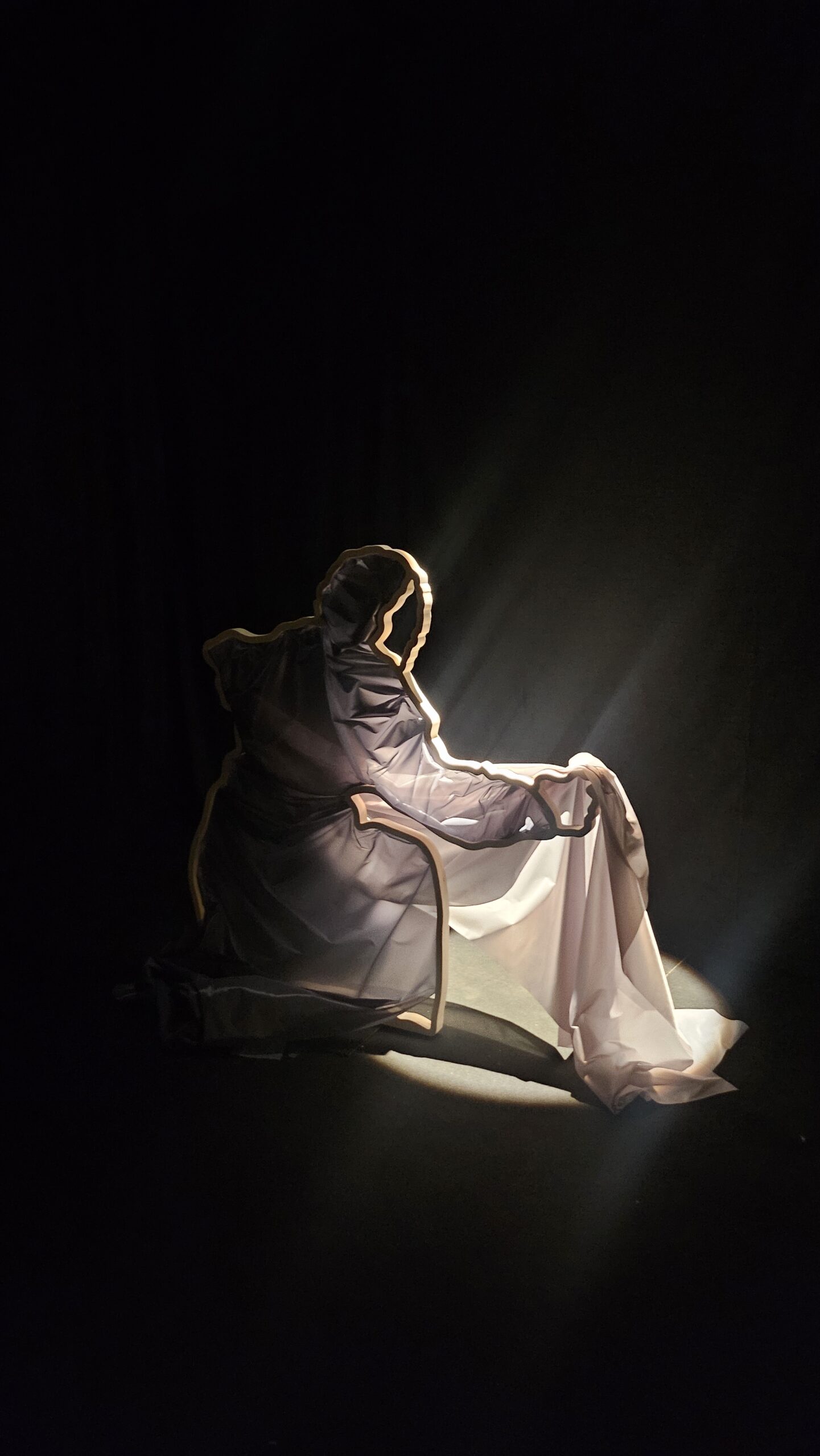
After the usual entrance portal and the room with panels explaining the painting’s history and how the original version might have been (more on that later), you cross through a nice installation room with a three-dimensional recreation of the main characters (aside from the baby Jesus, of course, since it’s not Christmas yet). Now this could have been super-tacky, but they decided to create the silhouettes of the figures in wood and paper, as if it’s stained glass, and the effective lighting creates a nice ambience.
Sorry about the video: I couldn’t take a nice picture of the whole thing…
The Painting’s History
It wouldn’t be an exhibition in 2025 without a bit of detective work, so here we go.
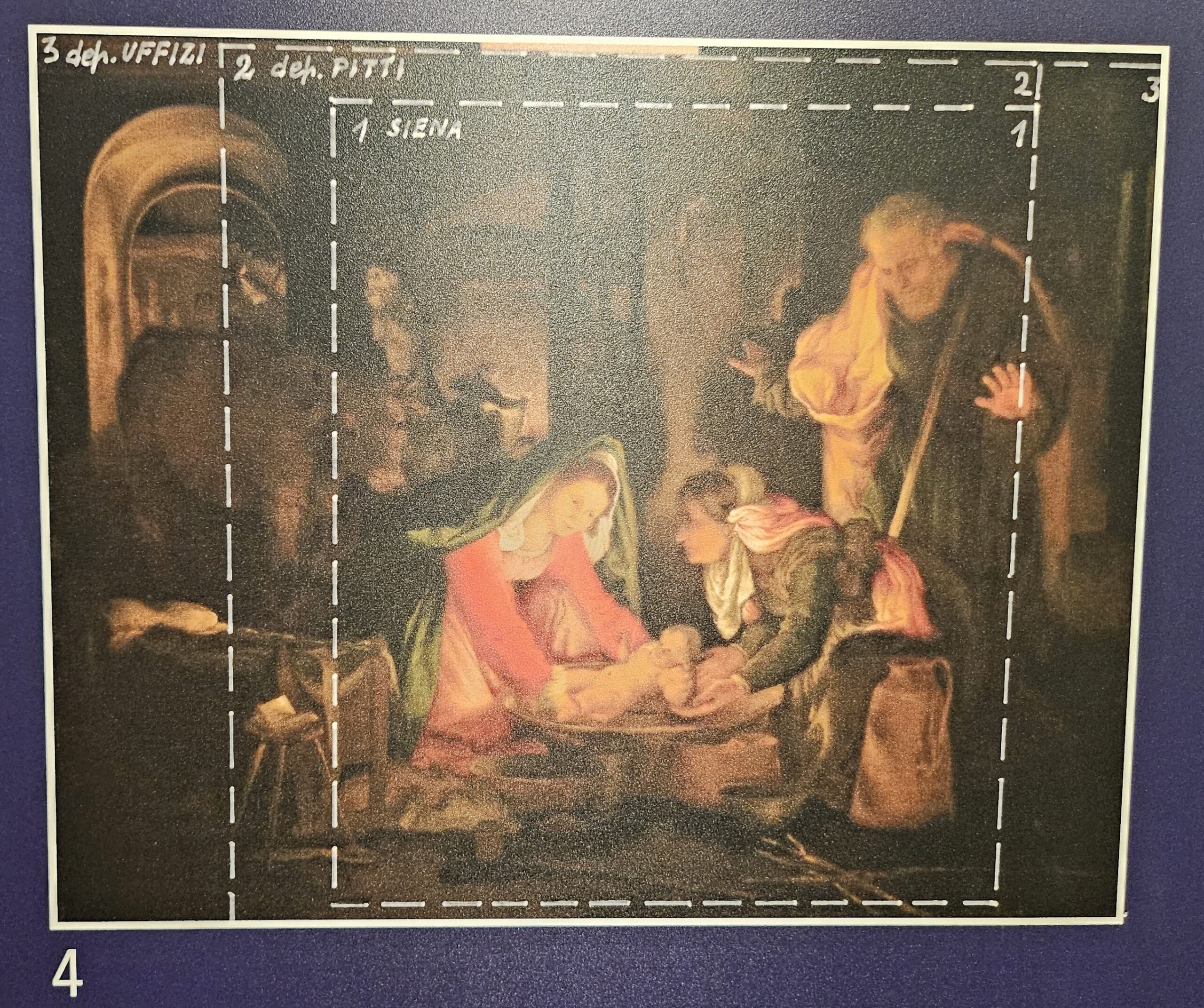
Historical sources already attest to the painting’s fragile condition in the eighteenth century, noting visible damage. By the time it entered the Pinacoteca Nazionale di Siena in the early twentieth century, the panel had already lost two lateral sections, likely removed due to severe deterioration. The original format — considerably wider than the present one — has been partially reconstructed through two early copies, which preserve elements now missing, such as the full architectural setting, the complete cradle, and additional figures.
The painting underwent major restorations in 1935 and 1998, followed by a structural intervention on the support in the 1990s. The most recent conservation campaign, completed in 2018, was preceded by an extensive program of scientific diagnostics, including infrared reflectography, false-colour infrared imaging, ultraviolet fluorescence, X-radiography, and XRF pigment analysis. These investigations clarified the condition of the paint layers, identified earlier retouchings and adhesive residues, and guided a conservative intervention aimed at long-term stability.
The final restoration employed tratteggio integration in areas of loss, particularly in zones crucial to the lighting structure of the composition. This approach reinstated the balance between light and shadow without falsifying the original surface, restoring the painting’s visual coherence and legibility while respecting its material history.

No Comments