
As my readers know by now, I often treat science fiction as a testing ground for architectural imagination. Not because it delivers ready-made templates for cities of the future, but because it probes the limits of what we think cities can be. Readers in architecture and engineering know this terrain well, or at least they should: the speculative city, drawn in words rather than plans, is already a familiar tool for thinking beyond zoning codes, construction details, or masterplans. What matters here is not the plausibility of the design but the way it refracts our own present through the lens of the strange.
This week, if you’ll bear with me, we’ll explore not the dream of futures we might build, but the persistence of futures we won’t. Cities that collapse under their own logic, utopias that curdle, infrastructures that betray the people they are meant to serve. In literature, failure is not a planning error to be corrected but a narrative strategy. A way of unsettling techno-optimism, of revealing what we refuse to confront in our own urban present. By paying attention to these broken or impossible blueprints, we can begin to see more clearly the hidden assumptions of real-world urbanism: the faith in growth, the seduction of control, the fantasy that design alone can guarantee social harmony.
In the paragraphs that follow, we’ll trace a few of these impossible architectures. With J.G. Ballard, we’ll watch towers turn into prisons of class warfare, as in High-Rise. With Ursula K. Le Guin, we’ll glimpse the anarchist experiment of The Dispossessed, where fragility rather than abundance defines utopia. With Samuel R. Delany, we’ll wander through the fractured, unfinished city of Dhalgren. And in a brief detour to Asimov’s The Naked Sun, we’ll see how urban form itself can encode social pathology, with its planet of sprawling estates designed to keep people apart. Taken together, these failures are not mistakes but provocations: sketches that force us to question what it means to build, to sustain, and to live together.

1. Imagined Ruins: J.G. Ballard’s Psychotopias
“They thrived on the rapid turnover of acquaintances, the lack of involvement with others, and the total self-sufficiency of lives which, needing nothing, were never dissapointed.”
― J.G. Ballard, High-Rise
J.G. Ballard’s cities are never stable settings, but protagonists in collapse. In The Drowned World (1962), London is submerged beneath tropical lagoons, its drowned towers poking through a world reverting to primaeval swamp; in High-Rise (1975), a luxury apartment block spirals into violence, as its self-sufficient amenities turn neighbours into enemies. These are psychotopias: spaces that externalise inner drives, showing what happens when architecture stops being a frame for life and becomes a mirror of human entropy.
Ballard is fascinated by failure as a design principle. The high-rise does not collapse because it is poorly engineered; it collapses because its perfection isolates. Its swimming pools, supermarkets, and endless corridors separate residents from the street, eroding the social fabric. The drowned city, conversely, is the ultimate state of entropy: infrastructure slowly reclaimed by the climate, order yielding to the passage of time. In both, the built environment is less a solution than a trigger for breakdown.
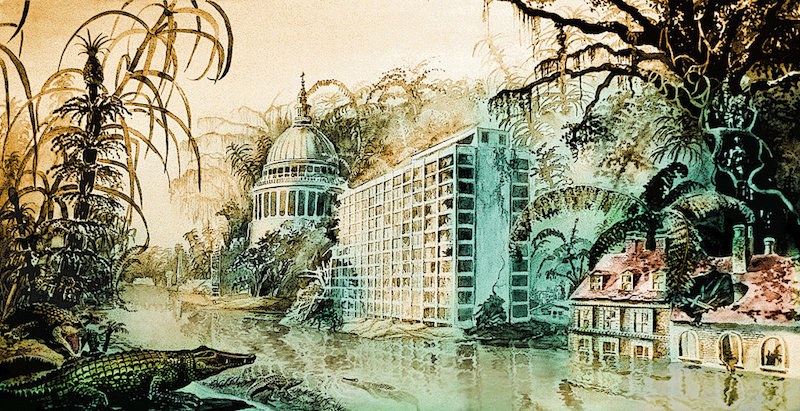
Parallels are not difficult to find in real urban history. The isolated vertical communities of High-Rise echo the failures of 20th-century housing estates like Pruitt-Igoe in St. Louis, where the promise of modernist efficiency collapsed into abandonment within two decades. More recently, luxury towers in London, Dubai, or Hong Kong have been criticised as vertical enclaves: social segregation stacked rather than spread, with minimal contact between classes or neighbours. Ballard’s flooded London, meanwhile, anticipates images from New Orleans after Hurricane Katrina or the projections of Miami’s streets under rising seas. In these cases, failure is not only fictional: it is the unintended consequence of urban form colliding with social or ecological reality.

What Ballard offers, then, is a method: imagine the city pushed past its breaking point, and watch how people adapt, fracture, or regress. In his worlds, architecture is not salvation but a stress test of the human psyche. The city is always already a ruin: the only question is how long it will take to see it.
2. Ursula K. Le Guin and the Fragile City of Ideals
“My world, my Earth is a ruin. A planet spoiled by the human species. We multiplied and fought and gobbled until there was nothing left, and then we died. We controlled neither appetite nor violence; we did not adapt. We destroyed ourselves. But we destroyed the world first.”
― Ursula K. Le Guin, The Dispossessed: An Ambiguous Utopia
If Ballard’s cities dramatise collapse, Ursula K. Le Guin’s The Dispossessed (1974) explores something rarer: the city that almost works. Anarres, the anarchist moon, is not presented as a gleaming utopia but as a hard-won, precarious experiment in collective living. Its architecture and urban form reflect this ethos. Sparse, utilitarian dwellings, public canteens, and communal workspaces are designed not for comfort or display but for survival in a desert world where resources are scarce. Anarres embodies what we might call a utopia by subtraction: it is not built on abundance, but on a refusal — the rejection of private property, hierarchy, and accumulation.

Scarcity becomes the city’s deepest design principle. Where Ballard imagines the tower overflowing with amenities, Le Guin imagines the settlement stripped of all excess. Urban life here is a choreography of compromises: food shortages mean rationing, architecture is reduced to bare function, and labour is distributed through a rotating system of postings that send inhabitants across disciplines and landscapes. The very fragility of Anarres is what keeps it alive. Unlike the smart city dreams of our present, promising seamless optimisation, Anarres works precisely because it never resolves into perfection.
And yet, Le Guin is unsparing in showing how ideals fray. Bureaucracy creeps in, peer pressure stifles dissent, and innovation struggles against the weight of conformity. Her protagonist, Shevek, a physicist, discovers that even in a society built to abolish authority, invisible forms of power persist: social ostracism, ideological rigidity, the inertia of institutions, you name it. These cracks are not a failure of imagination but the necessary shadows of utopia itself. Le Guin refuses to offer the fantasy of harmony without cost; instead, she insists that fragility and contradiction are what make the experiment real.
In urbanist terms, Anarres can be read against real-world experiments in intentional community and cooperative housing. From the kibbutzim of Israel to contemporary eco-villages in Europe or cohousing projects in Scandinavia, we see similar tensions between collective aspiration and the stubborn pull of individual desire. Even at larger scales, cities like Curitiba in Brazil or Freiburg in Germany — often celebrated for their sustainability — thrive less because they have “solved” urbanism than because they accept trade-offs: prioritising public transport over cars, green energy over industrial growth, density over sprawl. Like Anarres, their strength lies not in perfection but in navigating limits.
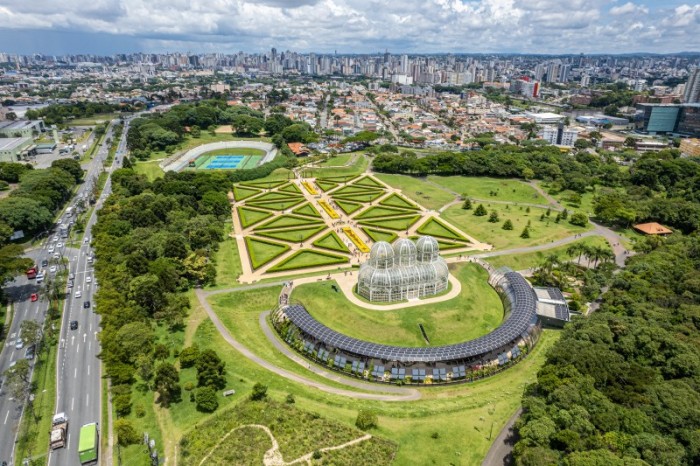
Le Guin’s great insight is that utopia, if it is to endure, must be porous to failure. The anarchist city survives not because it eliminates cracks, but because it learns to live with them and to treat scarcity, disagreement, and fragility not as signs of collapse but as conditions of resilience. In this sense, Anarres stands as a counterpoint to Ballard’s imploding towers: where abundance isolates and destroys, fragility forces cooperation and improvisation. The future we’ll never quite build — a city without power or property — remains instructive precisely because of its incompleteness.
3. Samuel R. Delany’s Inhabited Heterotopias
“You meet a new person, you go with him and suddenly you get a whole new city…you go down new streets, you see houses you never saw before, pass places you didn’t even know were there. Everything changes.”
― Samuel R. Delany, Dhalgren
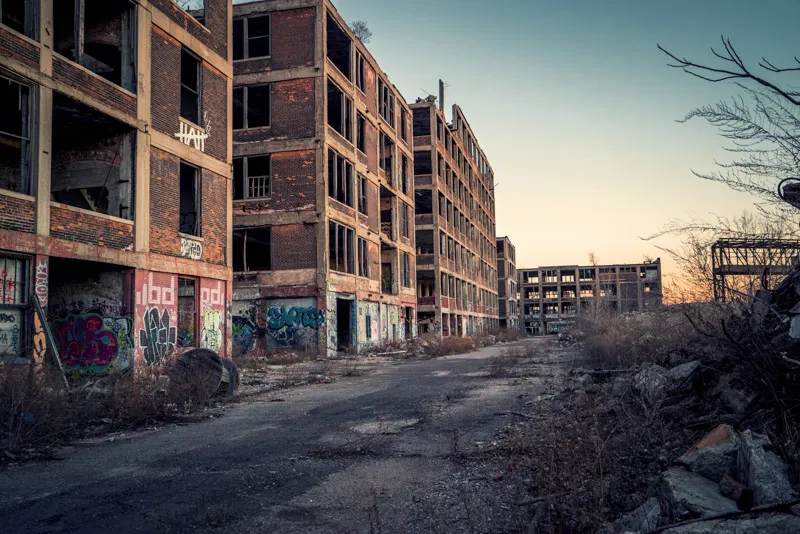
If Le Guin imagines a city held together by scarcity and compromise, Samuel R. Delany, in Dhalgren (1975), offers a metropolis that is already broken and yet endlessly lived in. Bellona, the fictional American city at the novel’s centre, has suffered some unnamed catastrophe. Buildings are gutted, infrastructure lies in disrepair, and whole districts are abandoned — but the city is not empty. Instead, it teems with squatters, gangs, drifters, and artists who inhabit its ruins with a mix of improvisation and defiance. Where Ballard’s collapse leads to regression, Delany’s collapse breeds heterogeneity.
Bellona is a heterotopia in the Foucauldian sense: a space where multiple orders of reality coexist, contradict, and overlap. It is fragmented, polyglot, erotic, and unstable. Time itself behaves strangely as days loop, events blur, the city resists any coherent map. Yet in this disorientation, Delany constructs a radical possibility: that unfinished and broken architecture can be lived, even celebrated. The ruin is not merely a symbol of failure but a canvas for reinvention.
Delany’s treatment of ruins departs from the melancholic tradition of the picturesque, where decay is admired from a safe distance. In Dhalgren, ruins are not aestheticised — they are lived. The characters transform abandoned apartments into homes, wrecked factories into stages, streets into spaces of erotic encounter. Bellona’s architecture is not backdrop but active participant, shaping identities through its incompleteness. In this sense, the city becomes a mirror for the queer and marginalised subject: improvised, unstable, illegible to dominant norms, but vital precisely in its refusal to be “finished.”
Real-world parallels can be found in cities where abandonment has not led to emptiness but to new, unexpected forms of life. Detroit is perhaps the clearest example: while often narrated through the lens of decline, its vacant lots and derelict factories have also become sites of community gardens, art installations, and experimental living. Similarly, Berlin after the fall of the Wall became a laboratory of squats, clubs, and countercultural practices that thrived in interstitial spaces before being reabsorbed into the logics of redevelopment. In both cases, the unfinished city reveals how ruins can be not just reminders of failure but conditions for alternative forms of belonging.
Delany pushes this further by entwining the city’s fragmentation with questions of identity and queerness. Bellona is a place where categories blur: gender roles shift, sexualities proliferate, racial and class boundaries are unstable. The city itself becomes uncanny, a space where normative coordinates fail, forcing its inhabitants to negotiate new forms of intimacy and community. This is the urban uncanny not as horror but as possibility. Cities are not only infrastructures of control but also spaces of becoming.
Through Dhalgren, Delany offers an urbanism of the unfinished: messy, unstable, and often unreadable to outsiders, yet deeply alive. If Ballard’s psychotopias are warnings, and Le Guin’s Anarres is an experiment, Bellona is something else: an inhabited heterotopia that thrives precisely because it cannot be mastered.
4. Lessons for Real-World Urbanism
What do these imagined failures offer to those working in the real cities of today? At first glance, Ballard’s flooded ruins, Le Guin’s anarchist communes, and Delany’s haunted heterotopias may seem too far removed from zoning boards or climate policy to be useful. Yet their power lies precisely in their estrangement: they make visible what our present-day urbanism too easily obscures. Failed futures are not simply cautionary tales; they are mirrors that throw our assumptions back at us in distorted, revealing ways.
Take techno-optimism. The rhetoric of “smart cities” promises seamless control, endless data, and predictive management of urban life. Against this vision, Ballard’s towers remind us that abundance and automation do not guarantee community; they may instead foster isolation, rivalry, and collapse. Le Guin’s Anarres reminds us that sustainability is not the product of infinite resources but of negotiated limits — and that utopia cannot be engineered without fragility. Delany’s Bellona reminds us that ruins are not only symbols of failure but spaces of possibility, where unfinished structures host new forms of life.
These lessons converge around a central critique: the myth of the perfect city is not only unattainable, it is dangerous. In our present, perfection takes the form of the frictionless smart city, built to optimise flows of traffic, energy, and consumption. But perfection tends to erase difference, to iron out cracks, to dismiss the very qualities — improvisation, adaptability, dissent — that make cities resilient. The failures imagined in science fiction suggest another model: a city that is antifragile, that draws strength from stress and fracture, that learns not by erasing contradictions but by accommodating them.
For practitioners, the ethical lesson is clear. Urban design is never just technical problem-solving; it is a negotiation with uncertainty, conflict, and desire. Ballard warns us not to mistake infrastructure for community. Le Guin shows us that fragility can be a condition of solidarity rather than a threat to it. Delany insists that unfinished spaces and marginalised identities belong at the centre, not the margins, of our imagination of the city. Together, they remind us that to design ethically is not to eliminate failure but to design with it. To leave room for cracks, experiments, and unplanned encounters.
In this sense, the futures we will never build are perhaps the most important ones to consider. They keep us from believing that design alone can guarantee harmony, and they push us to confront the messy, improvisational, and often contradictory reality of urban life. Failure, in these literary blueprints, is not the end of the city but the beginning of its most human possibilities.
Conclusion – Embracing the Unbuildable
What science fiction gives us, at its best, is not a manual for the future but a training ground for imagination. Ballard, Le Guin, and Delany do not offer cities we should emulate; they give us cities we could not, and perhaps should not, ever build. Their towers, communes, and heterotopias are laboratories of failure, where architecture dramatises entropy, scarcity, and fracture. Yet in these very impossibilities lies their enduring power. By staging a collapse, they free us to see the vulnerabilities we prefer to ignore. By sketching unbuildable blueprints, they reveal the assumptions we smuggle into our own urban visions: that abundance guarantees cohesion, that ideals erase conflict, and that technology will smooth over difference.
The impossible is not useless; it is critical imagination at work. It allows us to practice thinking otherwise, to resist the seductions of inevitability. Futures we’ll never build matter because they sharpen our ethical vision in the present. They teach us that failure is not the opposite of design but one of its conditions, that fragility can be resilience, and that the unfinished city may be the most human city of all.
As professionals, students, and citizens, we need these speculative ruins, fragile utopias, and inhabited heterotopias as reminders: the real task is not to build the perfect city, but to live responsibly, imaginatively, and critically in the imperfect one we already have.


No Comments