
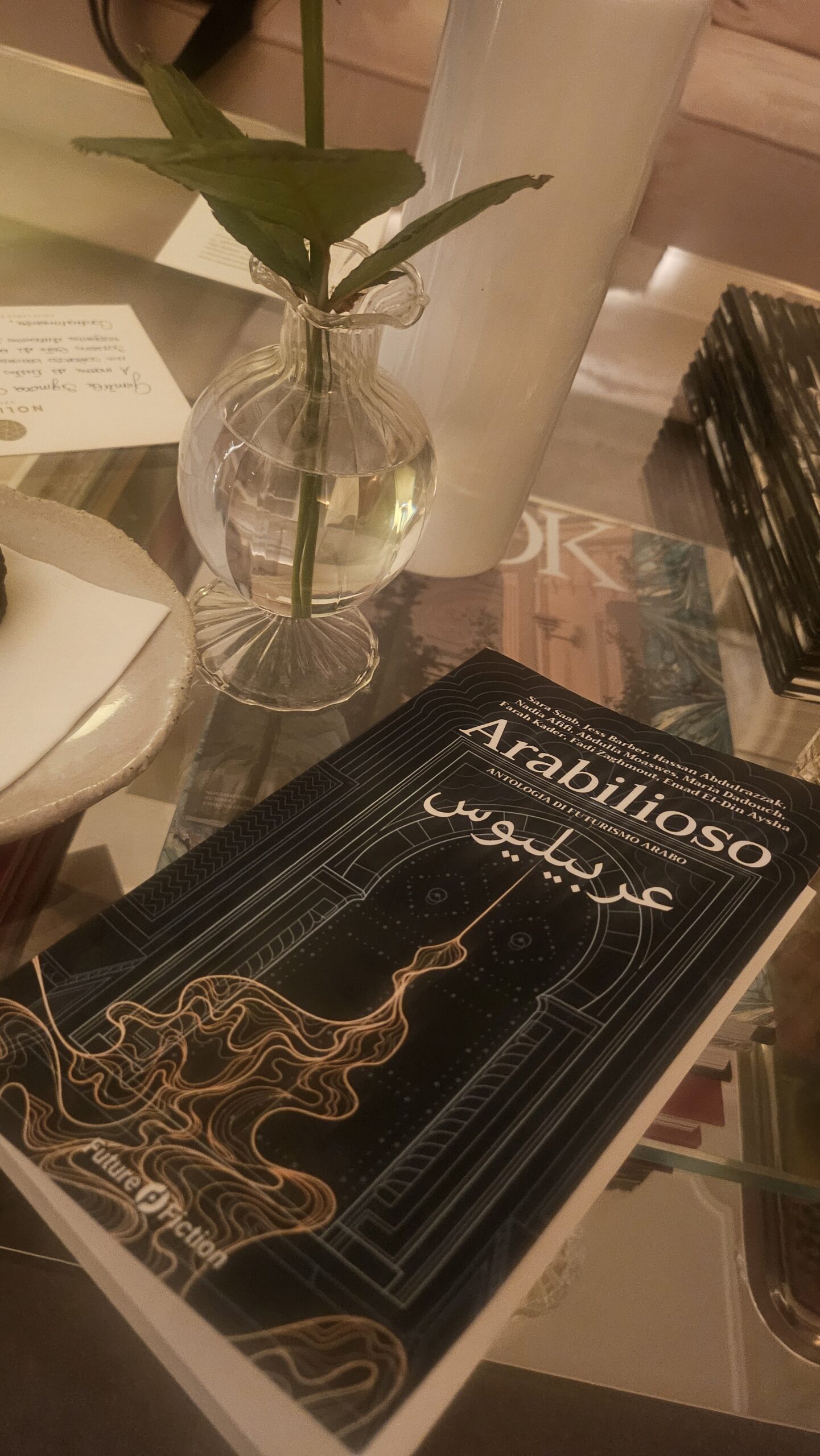
An astonishing anthology of what’s being called “Arabic futurism” because, as the preface explains well, the term “science fiction” is an invention of other cultures, and it might not apply to what we’re reading here.
And what is it that we’re reading here?
Stories about the future, a future that’s technological and dystopic at best, and yet full of optimism about young people’s will to be a force for change. The world sucks; people generally don’t. That’s the fil rouge that struck me in reading the nine short stories comprised in this book. So let’s see what they are.
“Pan-humanism Hope and Pragmatics” by Sara Saab and Jess Barber was one of my least-favourite stories: it starts off fine, with the setting and the lack of water being vividly depicted through the setting of foam showers and a nice screenshot of society, and yet I couldn’t bring myself to bring a single fuck about the group of gender-fluid hippies and their studies.
The second story, “The Standard of Ur” by Hassan Abdulrazzak from Iraq is, on the contrary, one of my favourites. An emissary from the British Museum goes to Iraq and he’s tasked to decide whether the local museum has “the right” to have back the titular relic, and its suitability revolves around the new social stability in the country, a stability gained through the forceful implant of a microchip in people’s brains. The ending got me up on my feet, clapping.
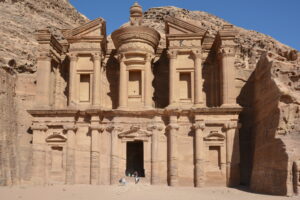
“The Bahrein Underground Bazar” by Nadia Afifi (Bahrain) is equally stunning, and features a terminally ill woman who buys immersive experiences of other people’s deaths in order to escape her own: an immensely delicate story about human strength and fragility, with a trip to Petra that will always do the trick.
“A Day in the Life of Anmar 20X1” by Abdulla Moaswes (Palestine) was powerful in the concept but I felt it was too blandly executed, the main character’s obviously a sad excuse for a human being, but that’s not something we couldn’t figure out as soon as the story starts, to I felt I wasn’t off for better of worse when I finished it.
A punch in the gut was “Cinammon Flavour Gum” by Maria Dadouch (Siria), set in a dystopic future where a plague of blindness has been sweeping through the globe but parents can still buy vaccines for their children by selling their organs. Like all of them. Which is something that happens in some parts of the world, if you don’t know, but what hits you here is the casual, disillusioned tone of the main character’s voice.
“To New Jerusalem” by Farah Kader is set… well, I won’t tell you where it’s set: the author comes from a Palestinian father and a US-citizen mother, and her story has everything: the seas rising with acid water, cities being destroyed like in the deepest dream-world of Inception, a main character for whom we can feel sympathy. And yet this too failed to deliver that final emotional punch I expect from a short story.
This cannot be said about “Exhibit K” by Nadia Afifi (Bahrain), in which a hibernated veteran from the Ecology Wars is revived and cured from cancer, as she expect, but is stuck in a place that’s half museum and half reality show, where her memories are played on screen for the amusement of visitors, she’s interview by sociology students, she’s asked to perform in reviving a famous battle of her history and, most crucially, she’s left to wonder: “where’s my husband and why didn’t you revive him with me?”
“A Jaha in the Metaverse” by Fadi Zaghmout (Jordan) and “Master of Mediterranean” by Emad El-Din Aysha (Egypt) are the two short stories that close the collection, and they’re diametral opposites in many ways: the first one is lighthearted, contemporary, and it might take place the day after tomorriw; the second one is so far away it might be historical fantasy. Is it a nice fantasy? Is it dystopia? It’s fucking hard to say.
I’d say my favourite is “The Bahrain Underground Bazaar”, with special mention for “The Standard of Ur” by Hassan Abdulrazzak.


No Comments