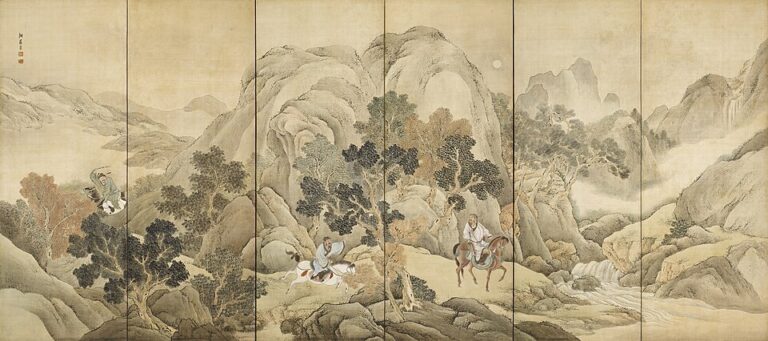
"All this he saw, for one moment breathless and intense, vivid on the morning sky; and still, as he looked, he lived; and still, as he lived, he wondered."

Fairytale Friday – The Golovikha

A certain woman was very bumptious. Her husband came from a village council one day, and she asked him:

“What have you been deciding over there?”

“What have we been deciding? why choosing a Golova.”

“Whom have you chosen?”

“No one as yet.”

“Choose me,” says the woman.

So as soon as her husband went back to the council (she was a bad sort; he wanted to give her a lesson) he told the elders what she had said. They immediately chose her as Golova.

Well the woman got along, settled all questions, took bribes, and drank spirits at the peasant’s expense. But the time came to collect the poll-tax. The Golova couldn’t do it, wasn’t able to collect it in time. There came a Cossack, and asked for the Golova; but the woman had hidden herself. As soon as she learnt that the Cossack had come, off she ran home.

“Where, oh where can I hide myself?” she cries to her husband. “Husband dear! tie me up in a bag, and put me out there where the corn-sacks are.”

Now there were five sacks of seed-corn outside, so her husband tied up the Golova, and set her in the midst of them. Up came the Cossack and said:

“Ho! so the Golova’s in hiding.”

Then he took to slashing at the sacks one after another with his whip, and the woman to howling at the pitch of her voice:

“Oh, my father! I won’t be a Golova, I won’t be a Golova.”

At last the Cossack left off beating the sacks, and rode away. But the woman had had enough of Golova-ing; from that time forward she took to obeying her husband.

Before passing on to another subject, it may be advisable to quote one of the stories in which the value of a good and wise wife is fully acknowledged. I have chosen for that purpose one of the variants of a tale from which, in all probability, our own story of “Whittington and his Cat” has been derived. With respect to its origin, there can be very little doubt, such a feature as that of the incense-burning pointing directly to a Buddhist source. It is called—

Nex Friday: The Three Copecks.

Summertime

The Voice of Things

Francis Ponge, a French poet mostly concentrated on everyday objects, wrote Le Parti pris des choses in seclusion during the German occupation of France, and published it in 1942. The title is usually translated into English as Taking the Side of Things (or The Nature

Read More »
architecture, engineering and construction

The Sustained Path

Every text this last few days has, in one way or another, been circling around the same question: what’s a path and what makes a path? Not a road already drawn and simply walked afterward, but a path in the sense that seems to keep

Read More »
Summertime

The Road is Made by Walking

Antonio Machado was a major Spanish poet and playwright, associated with the Generation of ’98, a group of writers who reflected on Spain’s identity and crisis at the turn of the 20th century. He was born in Seville in 1875 and died in 1939 in

Read More »
Share on LinkedIn
Throw on Reddit
Roll on Tumblr
Mail it
No Comments

Post A Comment

This site uses Akismet to reduce spam. Learn how your comment data is processed.

RELATED POSTS

The Voice of Things

Francis Ponge, a French poet mostly concentrated on everyday objects, wrote Le Parti pris des choses in seclusion during the German occupation of France, and published it in 1942. The title is usually translated into English as Taking the Side of Things (or The Nature

Read More

The Sustained Path

Every text this last few days has, in one way or another, been circling around the same question: what’s a path and what makes a path? Not a road already drawn and simply walked afterward, but a path in the sense that seems to keep

Read More

The Road is Made by Walking

Antonio Machado was a major Spanish poet and playwright, associated with the Generation of ’98, a group of writers who reflected on Spain’s identity and crisis at the turn of the 20th century. He was born in Seville in 1875 and died in 1939 in

Read More