"All this he saw, for one moment breathless and intense, vivid on the morning sky; and still, as he looked, he lived; and still, as he lived, he wondered."

Pride Month 2025 – Words of the Day

The Love That Wrote Itself: Hadewijch and the Ecstasy of the Unknown Beloved

“And she beheld me with love,
and made me forget all my suffering.”
Hadewijch of Brabant, Visions and Poems (13th century)

In the heart of the 13th century Low Countries, amidst convent walls and cloistered contemplation, a voice emerged that transcended both theology and genre. Hadewijch of Brabant, a Beguine mystic and poet, wrote in a Dutch that glowed with lyric fire. Her writings — part mystical vision, part romantic confession — are among the earliest known literary works in her vernacular, and among the most radically intimate articulations in medieval Europe.

Hadewijch does not write of God in distant abstractions. Her Beloved is immediate, bodily, rapturous—sometimes Christ, sometimes a genderless flame, sometimes unmistakably female in voice and presence. In her poetry and prose visions, she is taken up, undone, and re-formed by love, not metaphorically, but sensually, ecstatically, sometimes erotically.

The line between divine and human love collapses in her hands. She speaks of longing that burns the body, of kisses that tear the soul open, of gazes that erase everything else. And she does so without apology. The feminine pronoun in the fragment above — “she held me in her gaze” — appears more than once in her works, challenging attempts to flatten her mysticism into safe orthodoxy.

Whether we read Hadewijch as a mystic, a proto-lesbian poet, a visionary, or all three at once, one truth remains: her language carves out a space where love exceeds all binaries: of gender, of flesh, of faith. In that space, the divine is not male, not removed, but intensely close, tender, and transformative.


Summertime

The Road is Made by Walking

Antonio Machado was a major Spanish poet and playwright, associated with the Generation of ’98, a group of writers who reflected on Spain’s identity and crisis at the turn of the 20th century. He was born in Seville in 1875 and died in 1939 in

Read More »

Kathleen Jamie on Attention and Corridors

Kathleen Jamie is a Scottish poet and essayist, born in 1962, known for her prose and poetry about landscape, place, and everyday life. Findings is her essay collection of personal reflections, first published in 2005, and it moves through nature and cities, archaeology, hospitals, family

Read More »
comics and illustration

Leo Ortolani, Tapum

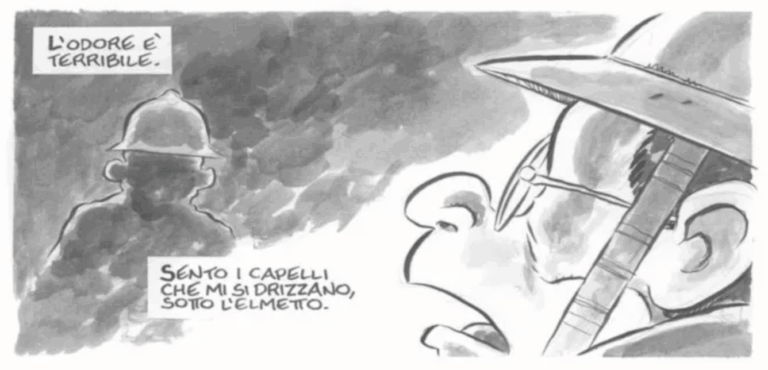
A un certo punto ci sarà una battuta, in questo fumetto, e riderete. Sappiate che è l’unica. Com’è giusto che sia. Se devo paragonare quest’opera a qualcosa, il confronto più azzeccato è probabilmente lo spettacolo che Marco Paolini trasse dal Sergente nella neve di Rigoni

Read More »
Share on LinkedIn
Throw on Reddit
Roll on Tumblr
Mail it
No Comments

Post A Comment

This site uses Akismet to reduce spam. Learn how your comment data is processed.

RELATED POSTS

The Road is Made by Walking

Antonio Machado was a major Spanish poet and playwright, associated with the Generation of ’98, a group of writers who reflected on Spain’s identity and crisis at the turn of the 20th century. He was born in Seville in 1875 and died in 1939 in

Read More

Kathleen Jamie on Attention and Corridors

Kathleen Jamie is a Scottish poet and essayist, born in 1962, known for her prose and poetry about landscape, place, and everyday life. Findings is her essay collection of personal reflections, first published in 2005, and it moves through nature and cities, archaeology, hospitals, family

Read More

Leo Ortolani, Tapum

A un certo punto ci sarà una battuta, in questo fumetto, e riderete. Sappiate che è l’unica. Com’è giusto che sia. Se devo paragonare quest’opera a qualcosa, il confronto più azzeccato è probabilmente lo spettacolo che Marco Paolini trasse dal Sergente nella neve di Rigoni

Read More